Two engineers can have similar qualifications, comparable years of experience, and even work on projects of a similar scale, yet receive very different assessment outcomes from Engineers Australia. At first glance, this can seem difficult to explain. Many applicants assume that years of experience, job titles, or the size of a project determine the result.
Short answer
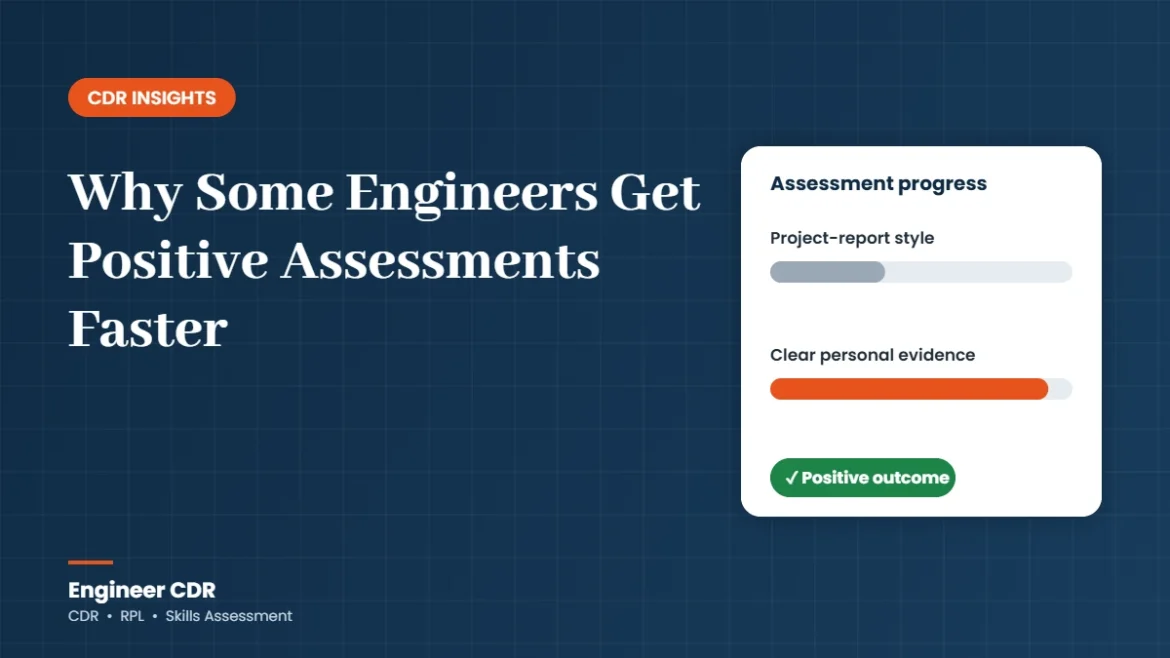
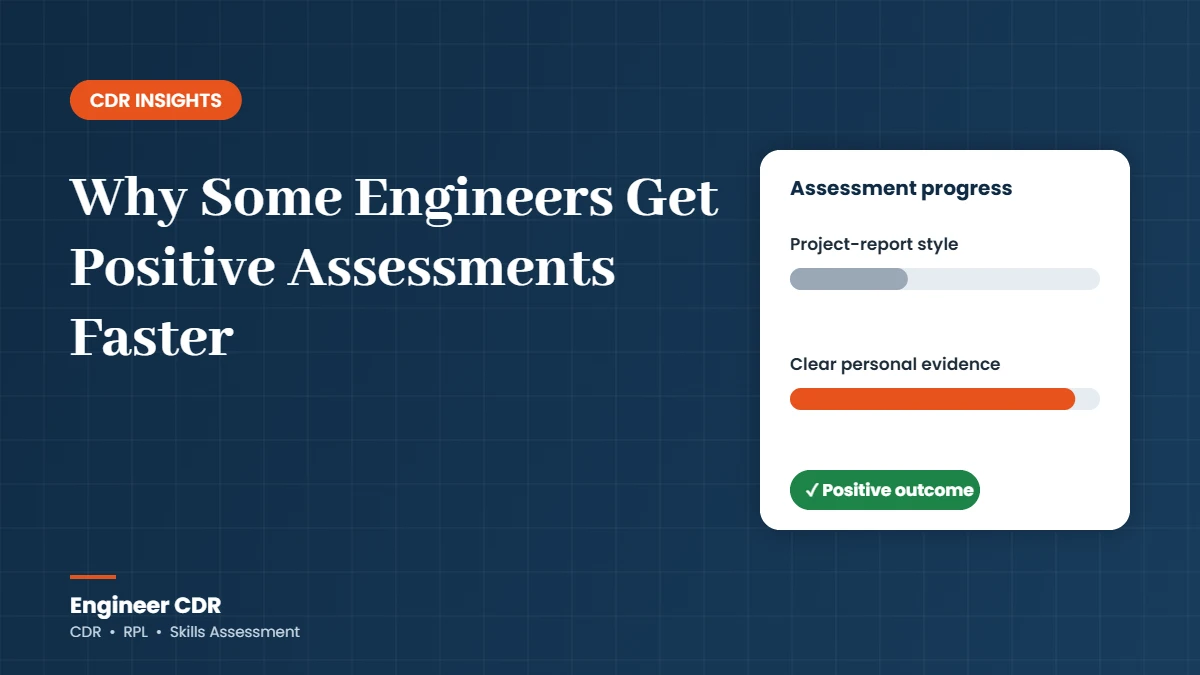
Faster, smoother assessments usually come from clear evidence, not bigger projects. CDRs that make each engineer’s personal decisions, judgement and technical ownership easy to see help assessors identify the required competencies without extra digging.
After helping engineers prepare Competency Demonstration Reports (CDRs) for more than 15 years, we’ve found that successful assessments are rarely influenced by who worked on the biggest project. More often, they reflect how clearly an engineer demonstrates professional judgement, technical ownership, and the ability to make sound engineering decisions. Understanding that distinction explains why some applications progress more smoothly than others.
A strong CDR makes an assessor’s job easier
Every Career Episode is reviewed by an assessor who must determine whether an applicant has demonstrated the engineering competencies expected by Engineers Australia. While every assessment follows established competency standards, the clarity of the evidence presented can significantly influence how easily those competencies are identified.
We’ve reviewed applications where highly experienced engineers unintentionally buried their strongest evidence beneath lengthy project descriptions. They explained the history of the project, listed completed activities, and described the organisation’s achievements, yet gave very little attention to the engineering decisions they personally made. When individual contributions are difficult to identify, assessors must work harder to connect the evidence with the required competencies.
The strongest applications do the opposite. They naturally guide the reader through the engineer’s thinking, making technical judgement, problem-solving, communication, and professional responsibility easy to recognise.
Engineering judgement creates confidence
We’ve found that assessors gain confidence in an application when an engineer clearly explains the reasoning behind technical decisions rather than simply describing project outcomes. Strong Career Episodes often demonstrate engineering judgement by showing how the engineer:
- Evaluated multiple technical solutions before selecting the most suitable option.
- Verified calculations to ensure safety and design accuracy.
- Balanced cost, performance, and reliability during decision-making.
- Identified potential risks and implemented practical mitigation measures.
- Took ownership of engineering decisions and justified them with sound technical reasoning.
These actions provide clear evidence of professional competency and make an engineer’s contribution easier for assessors to recognise.
Authentic problem solving demonstrates competency
One misconception we’ve encountered over the years is that Career Episodes should focus only on successful outcomes. In reality, some of the strongest applications begin with a genuine engineering challenge.
We once worked with a civil engineer responsible for supervising reinforced concrete works on a commercial building project. During routine inspections, the engineer noticed that the reinforcement placement on one section differed slightly from the approved structural drawings. The difference was small enough that it could easily have been overlooked, particularly with construction deadlines approaching.
Instead of allowing the work to continue, the engineer halted the activity, verified site measurements, reviewed the structural calculations with the design consultant, and confirmed that modifications were required before concrete placement. Although the decision delayed the schedule by a short period, it prevented a far more significant structural issue later in the project. The most valuable part of that Career Episode was not the delay itself. It was the reasoning behind the decision.
Technical ownership matters more than technical complexity
Another pattern we’ve consistently observed is that assessors are interested in what the engineer personally contributed, not simply what the project accomplished. Consider an electrical engineer involved in upgrading an industrial power distribution system.
| Generic Career Episode | Stronger Career Episode |
|---|---|
| Protection relays were installed | I analysed load data and identified coordination issues between protective devices |
| Testing was completed | I recalculated fault levels and adjusted relay settings |
| Commissioning was successful | I validated the revised configuration through testing and briefed the operations team before energising the system |
A generic Career Episode might explain that protection relays were installed, testing was completed, and the commissioning process was successful. A stronger Career Episode explains something different. It describes how the engineer analysed load data, identified coordination issues between protective devices, recalculated fault levels, adjusted relay settings, validated the revised configuration through testing, and communicated the changes with the operations team before energising the system.
Final thoughts
Engineers who receive positive assessments more smoothly are rarely the ones with the most impressive projects. They are the ones whose CDRs make their own thinking easy to see: the options they weighed, the checks they made, the risks they managed and the decisions they owned. If your experience is strong but your Career Episodes read like project reports, that is usually the first thing to change. Our guide to the engineering story behind every successful CDR explains how to bring that thinking forward.
Frequently asked questions
Does more work experience guarantee a faster CDR assessment?
No. Engineers Australia looks for clear evidence of competency. A well-written CDR that shows your personal decisions and judgement is usually more effective than a long list of years or job titles.
What makes a Career Episode easy for assessors to review?
Clear first-person descriptions of what you personally did, why you made each decision, the calculations or checks involved and how you communicated with others, mapped to the competency elements.
Should I include problems or mistakes in my Career Episodes?
Yes, if they are genuine. Showing how you identified and resolved an engineering problem is often strong evidence of judgement and responsibility.
How long does an Engineers Australia assessment take?
Processing times vary with demand and change during the year. A fast-track option is available for an extra fee, but a complete, well-written application is still the main factor you control.
What is the summary statement in a CDR?
It is a table that links each competency element to the paragraph numbers in your career episodes where you demonstrate it, so the assessor can find your evidence quickly.
Does fast track improve my chances?
No. Fast track only speeds up when your application is assessed. Your CDR must still meet the same standard.
Can I write a career episode about a university project?
Yes, if it demonstrates engineering competencies. Many applicants use one academic project and two workplace projects, but all episodes must show your personal engineering work clearly.
Should I number paragraphs in my career episodes?
Yes. Numbered paragraphs, such as 1.1 and 1.2, make it easy to reference evidence in your summary statement and help the assessor find it quickly.
What happens after you submit
- You lodge the application and upload documents through the Engineers Australia online portal.
- Your documents are checked for completeness: identity, qualifications, English language evidence, CV, CPD list, three career episodes and the summary statement.
- An assessor reviews your CDR against the competency standard for your occupational category.
- You receive an outcome, or a request for more information if something is unclear or missing.
Processing times vary with demand, and a fast-track option is available for an extra fee. Fast track speeds up when your application is picked up; it does not change the standard your CDR must meet. A clear, complete application is still the biggest factor you control.
Documents that commonly slow applications down
| Issue | Why it causes delay | How to avoid it |
|---|---|---|
| Missing or unclear employment evidence | The assessor cannot confirm your role or dates | Provide reference letters on letterhead with dates, duties and signatures |
| Untranslated documents | Documents must be understood as submitted | Use certified English translations alongside originals |
| Inconsistent dates or job titles | CV, CDR and references do not match | Cross-check every date and title before uploading |
| Weak summary statement | The assessor cannot find evidence for each element | Reference exact paragraph numbers for every competency element |
| Low-quality scans | Pages are unreadable | Upload clear, complete colour scans |
Use the summary statement to guide the assessor
The summary statement is a cross-reference table that links each element of the competency standard to the paragraphs in your career episodes where it is demonstrated. Number your paragraphs (for example 1.1, 1.2 in Career Episode 1) and cite them precisely. When an assessor can jump straight to the right evidence for each element, the review is faster and your competencies are far more convincing.
A pre-submission checklist
- Each career episode is written in the first person and shows what you did.
- Paragraphs are numbered and referenced in the summary statement.
- Every competency element is supported by at least one specific example.
- Dates, job titles and projects match across your CV, references and CDR.
- The CPD list is current and formatted with dates, duration and provider.
- Your CDR is original and has been checked for plagiarism.
How Engineer CDR can help
Engineer CDR works with engineers preparing Engineers Australia migration skills assessments. Our team can help you:
- Plan three strong career episodes from your real projects.
- Map your evidence to every competency element in the summary statement.
- Check documents, dates and references for consistency.
- Review and edit your CDR, with a plagiarism check before submission.
We work from your real projects and responsibilities, so the final CDR reflects your own engineering experience and you can explain every part of it. Message us on WhatsApp or email info@engineercdr.com for a free initial assessment, or see our CDR review, editing and plagiarism check.
How assessors read a career episode
Assessors usually read each career episode looking for four things: the context of the project, your specific role, the engineering work you personally carried out and the outcome. They then check whether that evidence matches the competency elements you claim in the summary statement. Episodes that follow this logic, with a short introduction, a clear background section, a detailed personal engineering activity section and a brief summary, are easier to assess than long narratives that mix context and personal work together.
| Career episode section | What the assessor looks for |
|---|---|
| Introduction | Dates, location, organisation and your position |
| Background | The project, its objectives and your role in the team |
| Personal engineering activity | What you did, the methods and calculations you used, problems you solved and decisions you made |
| Summary | The outcome, what you achieved and what you learned |
Why assessors ask for more information
- Your personal contribution is hard to separate from the team’s work.
- Employment evidence does not confirm the role described in the CDR.
- A career episode describes work that does not match your nominated occupation.
- The summary statement cites paragraphs that do not show the claimed competency.
A request for more information is not a refusal, but it adds time. Answer it fully and promptly, with the specific evidence requested, and keep your reply consistent with the rest of your application.
Small details that make a big difference
Number every paragraph, use consistent project names, write in clear plain English and keep each career episode within the recommended length. These small choices make your evidence easier to find and give the assessor confidence in the rest of your application.
Want your CDR to show your engineering judgement clearly?
Get a review, editing and plagiarism check of your own CDR against Engineers Australia’s requirements.

Leave a Reply