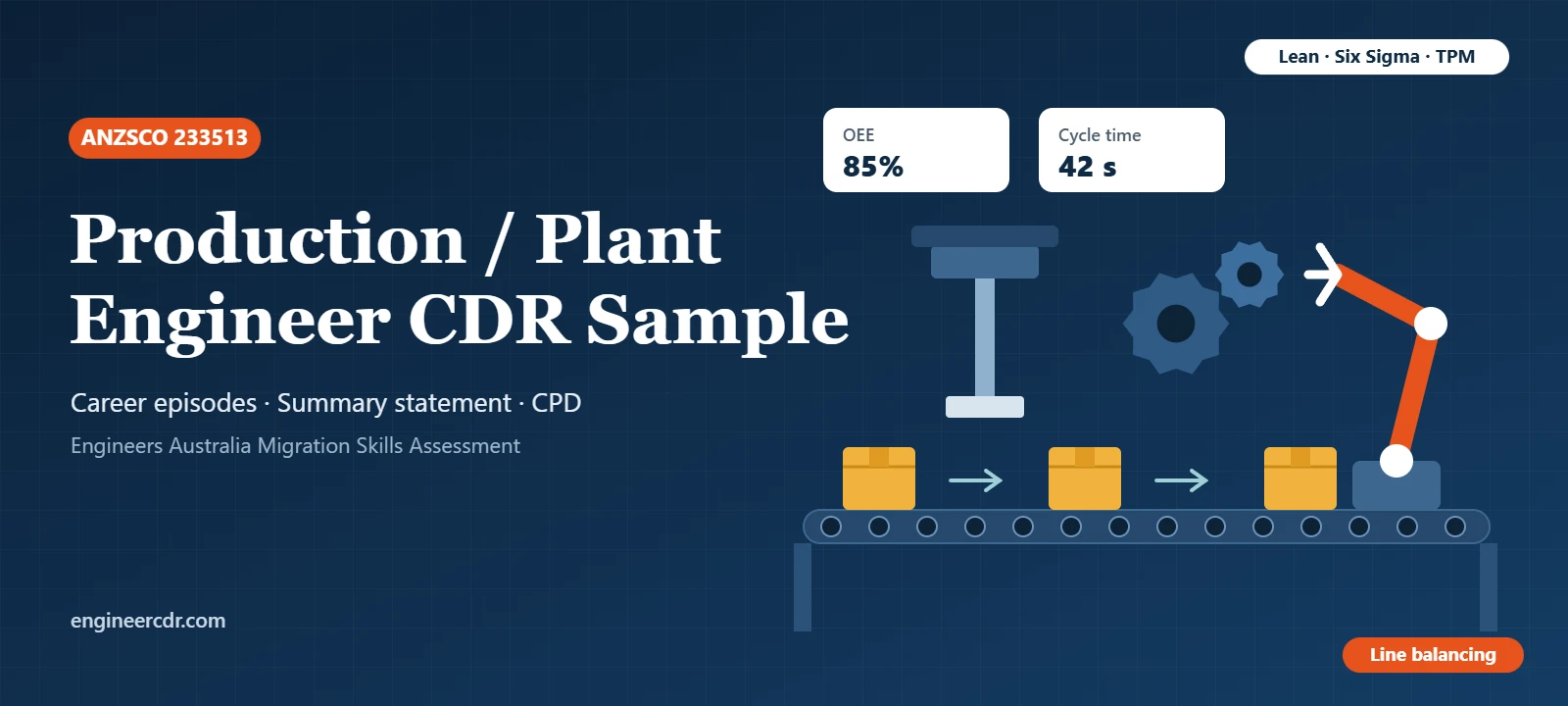
A CDR sample for a production or plant engineer shows how to structure the three career episodes, summary statement and CPD list that Engineers Australia assesses for ANZSCO 233513 (Production or Plant Engineer). This guide breaks down each part of a Production Engineering CDR, with career episode ideas, competency mapping, an illustrative excerpt and answers to the questions applicants ask most. Last updated: October 2026.
Write it yourself. Engineers Australia requires career episodes and the summary statement to be your own work. Copying a sample, or having another person or company write them, counts as plagiarism and can lead to rejection and a 12, 24 or 36 month reapplication ban. Use this page to understand the structure, then write from your own projects.
Production or Plant Engineer (ANZSCO 233513) at a glance
| Item | Detail |
|---|---|
| Occupation | Production or Plant Engineer |
| ANZSCO code | 233513 |
| Assessing authority | Engineers Australia (Migration Skills Assessment) |
| Competency standard | Stage 1 Competency Standard for Professional Engineer (16 elements of competency) |
| Core documents | CV, three career episodes, summary statement, CPD statement, ID, qualifications and English language evidence |
| Career episode length | 1,000 to 2,500 words each, first person, numbered paragraphs |
| Typical qualification | Bachelor degree in production, manufacturing, industrial, mechanical or mechatronics engineering, or a related field |
| Related occupations | Industrial Engineer (233511), Mechanical Engineer (233512) |
What is a CDR for a Production or Plant Engineer?
A Competency Demonstration Report (CDR) is the evidence pathway Engineers Australia uses to assess whether your qualifications and experience match the occupation you nominate. For a Production or Plant Engineer, the assessor looks for proof that you planned, designed, improved or managed production processes, plant and equipment at professional engineer level, such as manufacturing lines, process improvement, equipment commissioning, maintenance strategy and capacity planning.
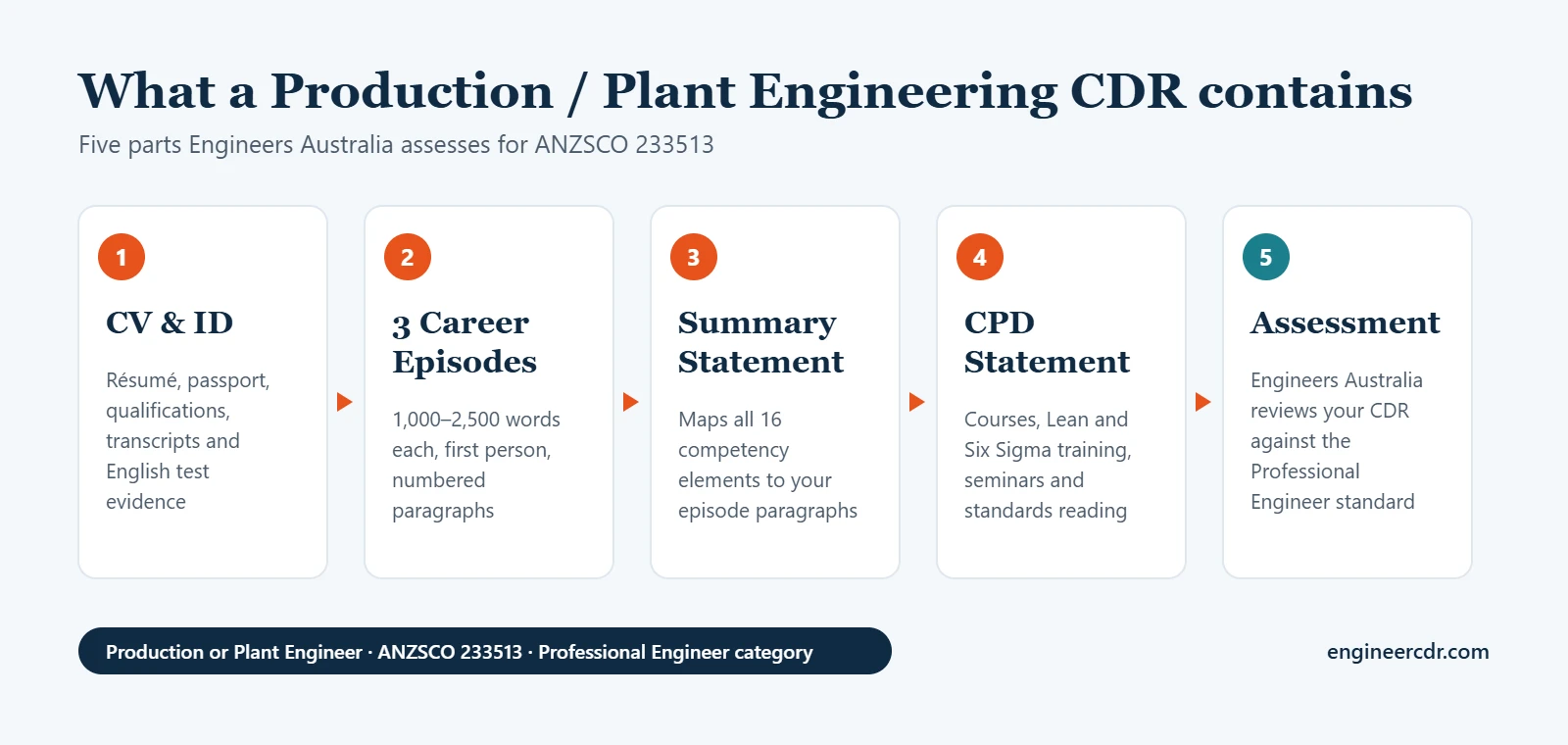
A CDR has three technical parts: three career episodes that describe your engineering work, a summary statement that maps your episodes to each competency element, and a CPD statement that lists your continuing professional development.
What does a Production or Plant Engineer do?
Production and plant engineers plan, run and improve the processes, machines and systems that turn materials into finished products safely, on time and at the right cost. Typical work you can draw on for your episodes includes:
- Planning production processes, plant layouts and line balancing
- Selecting, installing and commissioning plant and equipment
- Improving OEE, throughput, yield and changeover time
- Lean manufacturing, Six Sigma, Kaizen, 5S and SMED projects
- Preventive and predictive maintenance, TPM and reliability engineering
- Quality control, SPC and root cause analysis such as FMEA and 8D
- Health, safety and environmental risk assessments for plant and machinery
- Cost estimation, capital projects and vendor management
Production vs Industrial vs Mechanical Engineer CDR
These three occupations overlap, so many applicants are unsure which ANZSCO code to nominate. Engineers Australia assesses you against the occupation whose duties best match your qualifications and experience.
| Occupation | ANZSCO | Main focus of your episodes |
|---|---|---|
| Production or Plant Engineer | 233513 | Running, maintaining and improving plant, equipment and production processes |
| Industrial Engineer | 233511 | Systems efficiency, work methods, operations research, planning and logistics |
| Mechanical Engineer | 233512 | Design and analysis of machines, mechanical components and thermal systems |
If most of your work is on the shop floor improving lines, equipment and plant performance, ANZSCO 233513 is usually the closest fit. See also our Industrial Engineering CDR sample and Mechanical Engineering CDR sample.
What a Production Engineering CDR contains
| Component | What Engineers Australia expects | Tip for production and plant engineers |
|---|---|---|
| Career Episode 1 | An engineering activity or project, 1,000 to 2,500 words, in first person | Pick your strongest process improvement or commissioning project |
| Career Episode 2 | A different activity that shows other competencies | Show another skill, for example a maintenance or reliability study |
| Career Episode 3 | A third activity, which can be study-based for recent graduates | Cover project management, safety or cost work |
| Summary statement | Maps every competency element to numbered paragraphs in your episodes | Cross-reference paragraph numbers exactly |
| CPD statement | Written evidence of continuing professional development | Include Lean, Six Sigma, safety and software training |
| CV and supporting documents | Résumé, qualifications, transcripts, ID, English test evidence | Keep plant names, roles and dates consistent with your episodes |
Career episode ideas for Production and Plant Engineers
Choose projects where you made the engineering decisions. Strong options include:
- Production line balancing and layout redesign: time studies, precedence diagrams, takt time and a new station layout.
- OEE improvement programme: loss analysis, root causes and countermeasures that raised availability, performance or quality.
- SMED changeover reduction: separating internal and external tasks, tooling changes and standard work.
- Commissioning new plant or machinery: specification, vendor review, installation, trials and handover.
- Preventive maintenance or TPM programme: failure data analysis, maintenance schedules and reliability results.
- Six Sigma defect reduction: a DMAIC project with measurement, analysis, process changes and control plans.
- Energy efficiency project: compressed air leaks, variable speed drives or heat recovery, with savings calculations.
- Capacity expansion or automation upgrade: bottleneck analysis, equipment selection, cost and risk assessment.
- Final-year project or thesis: suitable for recent graduates, as long as you describe your personal contribution.
How to structure each career episode
Engineers Australia asks you to follow the engineering method of defining, planning and designing, delivering and evaluating. A clear four-part layout works well:
| Section | Approximate length | What to cover |
|---|---|---|
| Introduction | 50 to 100 words | Project title, dates, location, organisation, your position |
| Background | 200 to 500 words | Plant or product, project purpose, scope, stakeholders, standards, your team and your role |
| Personal engineering activity | 600 to 1,800 words | What you did: data collection, analysis, calculations, software, decisions, problems solved and results |
| Summary | 50 to 150 words | Outcome, KPIs before and after, what you delivered and what you learned |
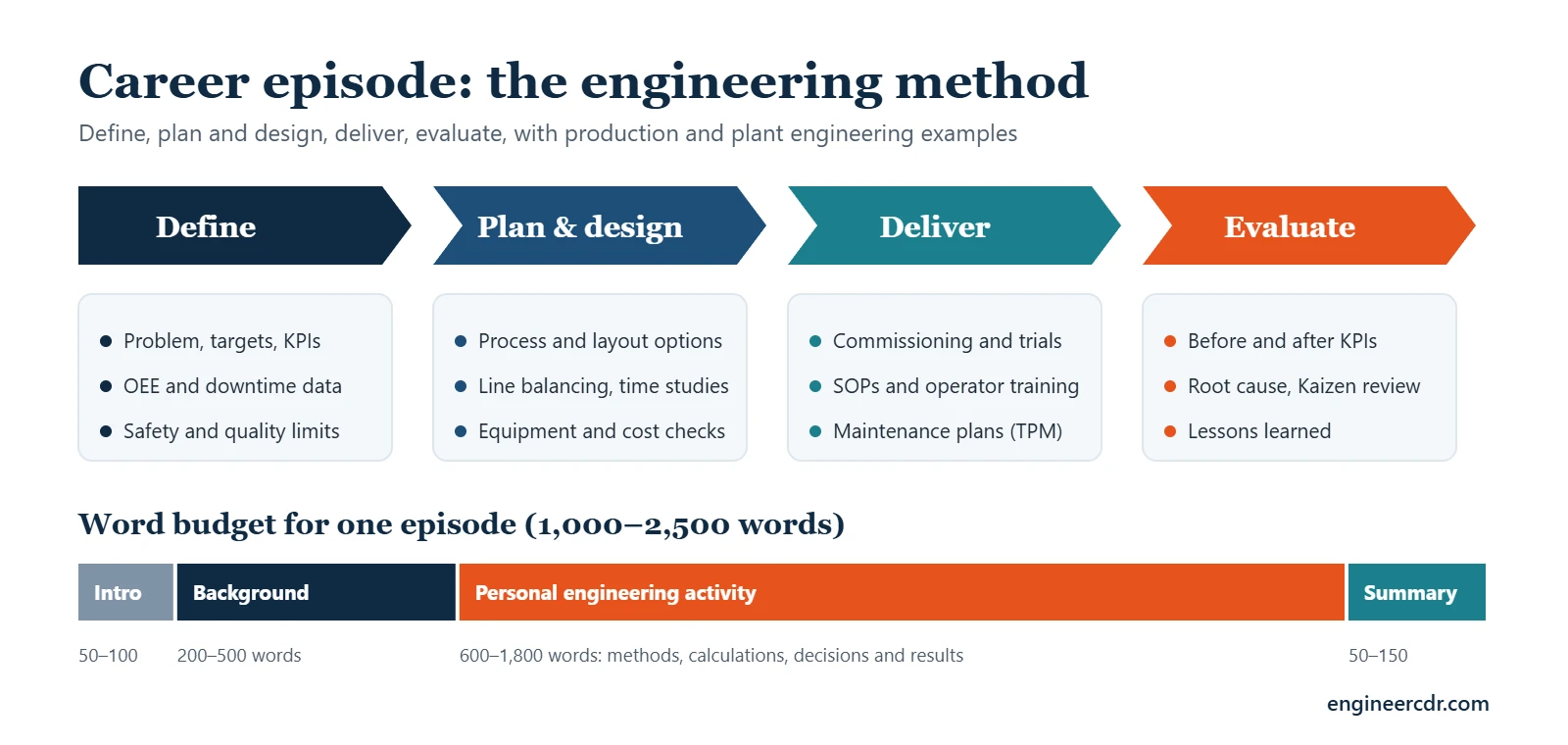
Write in the first person (“I analysed”, not “we analysed”), number every paragraph, and spend most of the word count on the personal engineering activity.
Illustrative excerpt (fictional, for structure only)
This short example is invented to show tone and level of detail. Do not copy it; your episodes must describe your own work.
CE 1.5 I carried out stopwatch time studies at each of the eleven workstations on the assembly line across three shifts and compared the station times with the takt time calculated from customer demand. Two stations exceeded the takt time and were causing work-in-progress to build up upstream.
CE 1.6 I drew a precedence diagram for all assembly tasks and reallocated work elements using the largest candidate rule. I then prepared a revised layout, checked operator reach and walking distances, and completed a risk assessment with the maintenance supervisor before the conveyor was moved. After the trial, the line ran with nine stations instead of eleven and the bottlenecks were removed.
How the summary statement maps competencies
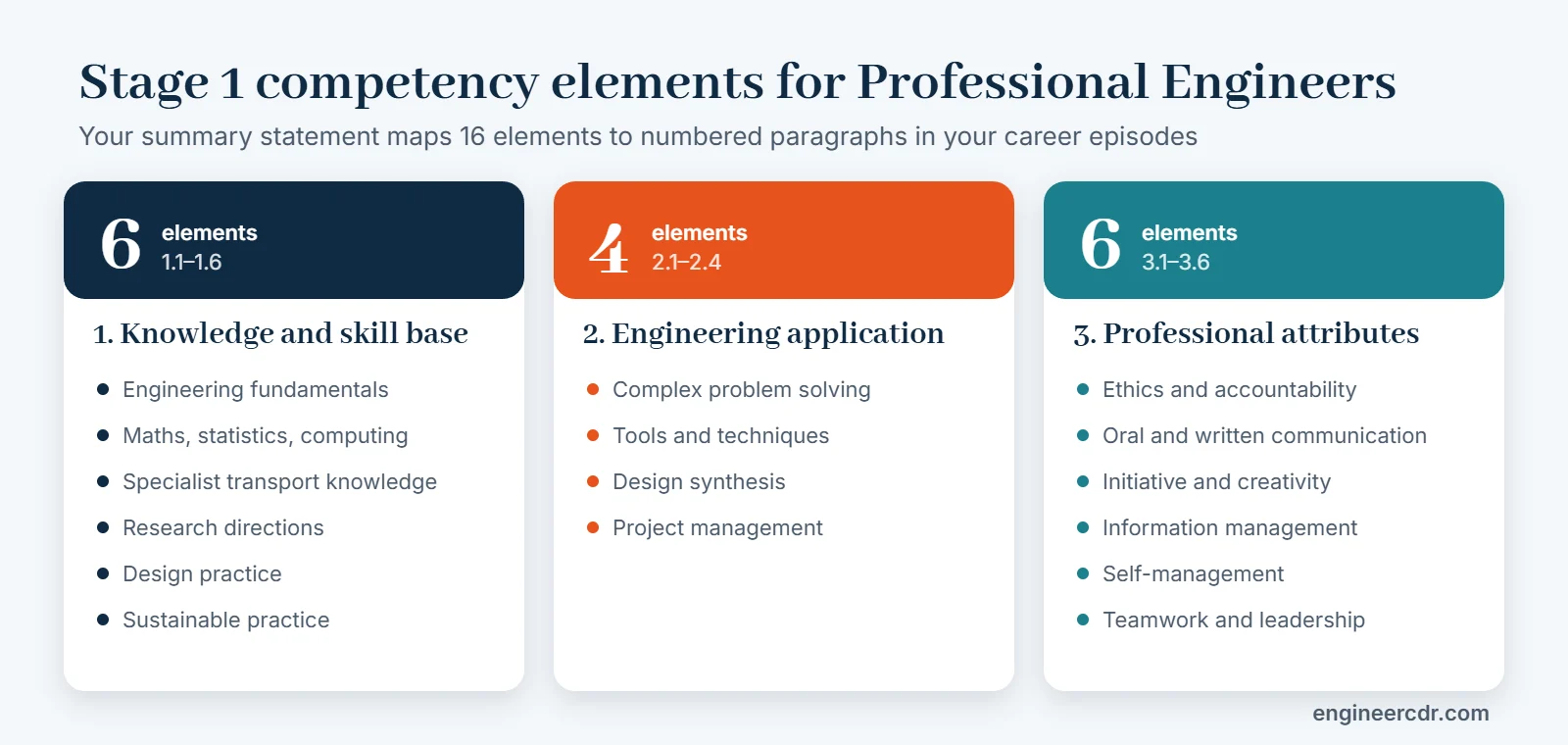
The summary statement is a table. For each of the 16 elements of the Stage 1 Competency Standard, you quote the paragraph numbers from your episodes where you demonstrated it. The elements fall into three areas:
| Area | Elements | Production engineering evidence |
|---|---|---|
| 1. Knowledge and skill base | 1.1 to 1.6 | Manufacturing processes, statistics and SPC, maintenance and reliability theory, design practice, sustainability |
| 2. Engineering application ability | 2.1 to 2.4 | Root cause problem solving, simulation and CAD tools, process and layout design, project management |
| 3. Professional and personal attributes | 3.1 to 3.6 | Safety and ethics, communication with operators and management, initiative, records, self-management, teamwork |
Use the official Engineers Australia summary statement template for the Professional Engineer category and make sure every element is covered at least once across your three episodes. Our summary statement guidance explains the mapping in more detail.
CPD examples for Production and Plant Engineers
| Activity type | Examples |
|---|---|
| Formal courses | Lean Six Sigma Green Belt, TPM, project management or industrial safety courses |
| Software training | AutoCAD, SolidWorks, Minitab, SAP PP or PM modules, MES and simulation tools |
| Seminars and conferences | Manufacturing, maintenance and reliability conferences, professional society events, webinars |
| Standards and self-study | ISO 9001, ISO 14001 and ISO 45001, machinery safety standards and technical papers |
| On-the-job learning | Kaizen events, vendor training on new equipment, mentoring, documented with dates and outcomes |
Common reasons a Production Engineering CDR is rejected
- Copied or ghost-written content that fails Engineers Australia’s plagiarism checks
- Using “we” so your personal contribution is unclear
- Episodes that read like operator or technician duties rather than engineering work
- Listing KPI results without explaining the analysis and decisions behind them
- Missing competency elements or wrong paragraph references in the summary statement
- Episodes shorter than 1,000 words or far above 2,500 words
- Dates, employers or plant names that do not match your CV
How to write your Production Engineering CDR, step by step
- Download the current Engineers Australia migration skills assessment booklet and competency templates.
- Confirm that ANZSCO 233513 matches most of your duties, compared with 233511 and 233512.
- List your projects and choose three with clear personal engineering work.
- Collect the data, KPIs, standards, software, calculations and results for each project.
- Draft each episode in four sections, in the first person, with numbered paragraphs.
- Complete the summary statement by mapping each competency element to paragraph numbers.
- Prepare the CPD statement and a CV that matches your episodes, then review for originality and consistency.
Frequently asked questions
How many career episodes do I need for a Production or Plant Engineer CDR?
You need three career episodes. Each should be between 1,000 and 2,500 words, written in English in the first person, with numbered paragraphs.
Can I copy a CDR sample for production or plant engineering?
No. Engineers Australia treats copied work, or work written by another person, as plagiarism. The consequences include rejection and a reapplication ban of 12, 24 or 36 months. Use samples only to understand structure.
Which authority assesses ANZSCO 233513 Production or Plant Engineer?
Engineers Australia assesses the Production or Plant Engineer occupation for migration skills assessment purposes, against the Stage 1 Competency Standard for Professional Engineers.
What is the difference between a Production Engineer and an Industrial Engineer CDR?
A Production or Plant Engineer (233513) CDR focuses on running, maintaining and improving plant, equipment and production processes. An Industrial Engineer (233511) CDR focuses more on systems efficiency, work methods, operations research and planning. Choose the code that matches most of your duties.
Can I use maintenance work as a career episode?
Yes, if the episode shows engineering work such as failure analysis, reliability improvement, a preventive maintenance programme or equipment selection. Routine repairs and operator tasks alone will not demonstrate professional engineer competencies.
What should a Production Engineer include in CPD?
Include courses such as Lean Six Sigma or TPM, software training, safety and quality standards reading, seminars and on-the-job learning, with dates, hours and what you learned.
Is Production or Plant Engineer on the skilled occupation list?
Production or Plant Engineer (233513) has been listed on Australia’s Core Skills Occupation List, but lists change. Check the Department of Home Affairs website and your visa subclass before you apply.
How long should a career episode be?
Between 1,000 and 2,500 words. Most of the text should explain the engineering work you personally did, including methods, calculations, decisions and results.
Get your Production Engineering CDR reviewed
Engineer CDR provides CDR review, editing and plagiarism checking and summary statement guidance, so your own draft is clear, consistent and competency-mapped. For service details, see our CDR for Production or Plant Engineers (ANZSCO 233513) page, or email info@engineercdr.com.
Want a second pair of eyes on your CDR?
Send us your own draft for review, editing and a plagiarism check against Engineers Australia’s requirements.
Related CDR samples and guides
- CDR sample for Industrial Engineering (233511)
- CDR sample for Mechanical Engineering (233512)
- CDR sample for Chemical Engineering (233111)
- CDR report samples and structure guide
Source: Engineers Australia, Prepare your Migration Skills Assessment application. Requirements can change, so always check the current booklet.
