
A CDR sample for a naval architect shows how to structure the three career episodes, summary statement and CPD list that Engineers Australia assesses for ANZSCO 233916 (Naval Architect). This guide breaks down each part of a Naval Architecture CDR, with career episode ideas, competency mapping, an illustrative excerpt and answers to the questions applicants ask most. Last updated: October 2026.
Write it yourself. Engineers Australia requires career episodes and the summary statement to be your own work. Copying a sample, or having another person or company write them, counts as plagiarism and can lead to rejection and a 12, 24 or 36 month reapplication ban. Use this page to understand the structure, then write from your own projects.
Naval Architect (ANZSCO 233916) at a glance
| Item | Detail |
|---|---|
| Occupation | Naval Architect |
| ANZSCO code | 233916 |
| Assessing authority | Engineers Australia (Migration Skills Assessment) |
| Competency standard | Stage 1 Competency Standard for Professional Engineer (16 elements of competency) |
| Core documents | CV, three career episodes, summary statement, CPD statement, ID, qualifications and English language evidence |
| Career episode length | 1,000 to 2,500 words each, first person, numbered paragraphs |
| Typical qualification | Bachelor degree in naval architecture, marine engineering, ocean engineering or a closely related field |
| Related occupations | Mechanical Engineer (233512), Structural Engineer (233214) |
What is a CDR for a Naval Architect?
A Competency Demonstration Report (CDR) is the evidence pathway Engineers Australia uses to assess whether your qualifications and experience match the occupation you nominate. For a Naval Architect, the assessor looks for proof that you designed, analysed or managed ships, boats, offshore structures or their systems at professional engineer level, such as hull form design, stability, structural design, resistance and powering, and compliance with class and statutory rules.
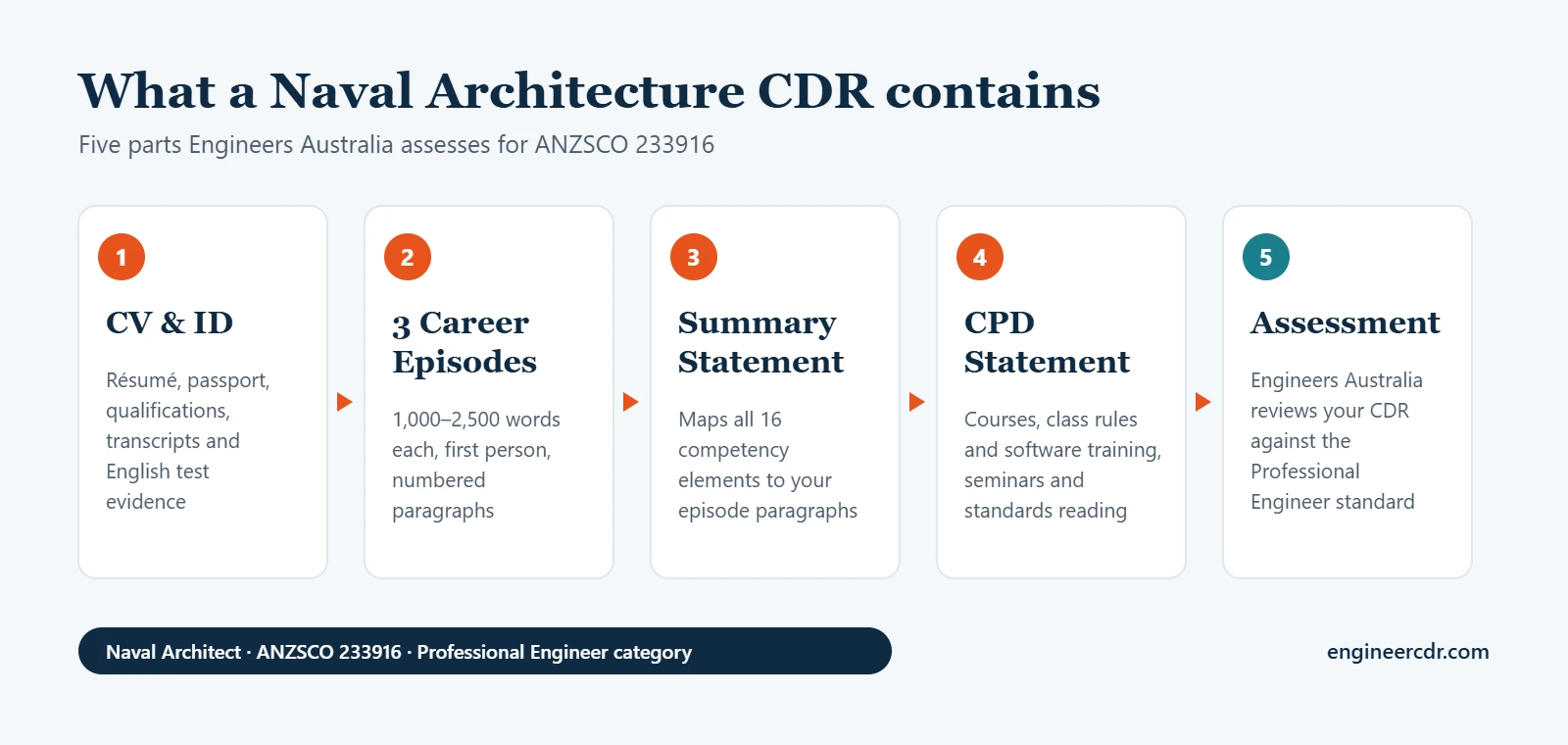
A CDR has three technical parts: three career episodes that describe your engineering work, a summary statement that maps your episodes to each competency element, and a CPD statement that lists your continuing professional development.
What does a Naval Architect do?
Naval architects design, analyse and approve vessels and floating structures so they are safe, stable, efficient and compliant. Typical work you can draw on for your episodes includes:
- Concept, basic and detailed design of ships, boats and offshore units
- Hull form development, hydrostatics and intact and damage stability
- Resistance, propulsion and powering predictions
- Structural design and scantlings to classification society rules, including FEA
- General arrangement, weight estimation and weight control
- Seakeeping, manoeuvring and mooring analysis
- Inclining experiments, stability booklets and sea trials
- Compliance with SOLAS, MARPOL, the IMO Intact Stability Code and national rules
Naval Architect vs Mechanical vs Structural Engineer CDR
Marine projects often involve several disciplines, so it is important to nominate the occupation that matches most of your work. Engineers Australia assesses you against the occupation whose duties best match your qualifications and experience.
| Occupation | ANZSCO | Main focus of your episodes |
|---|---|---|
| Naval Architect | 233916 | Design of the vessel as a whole: hull form, stability, structure, powering and regulatory compliance |
| Mechanical Engineer | 233512 | Machinery, propulsion plant, piping and mechanical systems on board or ashore |
| Structural Engineer | 233214 | Buildings and civil or offshore structures, such as wharves and fixed platforms |
If your work centres on hull design, stability and class approval, ANZSCO 233916 is usually the closest fit. Seagoing ship’s engineers are a separate occupation with a different assessment pathway. See also our Mechanical Engineering CDR sample.
What a Naval Architecture CDR contains
| Component | What Engineers Australia expects | Tip for naval architects |
|---|---|---|
| Career Episode 1 | An engineering activity or project, 1,000 to 2,500 words, in first person | Pick your strongest vessel design or stability project |
| Career Episode 2 | A different activity that shows other competencies | Show a different skill, for example structural analysis or a refit |
| Career Episode 3 | A third activity, which can be study-based for recent graduates | Cover project management, class liaison or sea trials |
| Summary statement | Maps every competency element to numbered paragraphs in your episodes | Cross-reference paragraph numbers exactly |
| CPD statement | Written evidence of continuing professional development | Include class rules seminars, software and stability training |
| CV and supporting documents | Résumé, qualifications, transcripts, ID, English test evidence | Keep vessel names, yards and dates consistent with your episodes |
Career episode ideas for Naval Architects
Choose projects where you made the engineering decisions. Strong options include:
- New vessel concept or basic design: owner requirements, main dimensions, hull form and general arrangement.
- Stability booklet and inclining experiment: lightship calculation, loading conditions and criteria checks.
- Resistance and powering prediction: empirical methods, CFD or model test data and propeller matching.
- Structural design to class rules: scantling calculations, FEA of critical areas and approval drawings.
- Vessel conversion or refit: lengthening, repowering or new equipment with updated weight and stability.
- Damage stability and compliance study: compartment analysis against SOLAS or other applicable rules.
- Offshore or mooring analysis: environmental loads, mooring line tensions and motion response.
- Weight control on a newbuild: estimates, tracking against yard data and corrective actions.
- Final-year project or thesis: suitable for recent graduates, as long as you describe your personal contribution.
How to structure each career episode
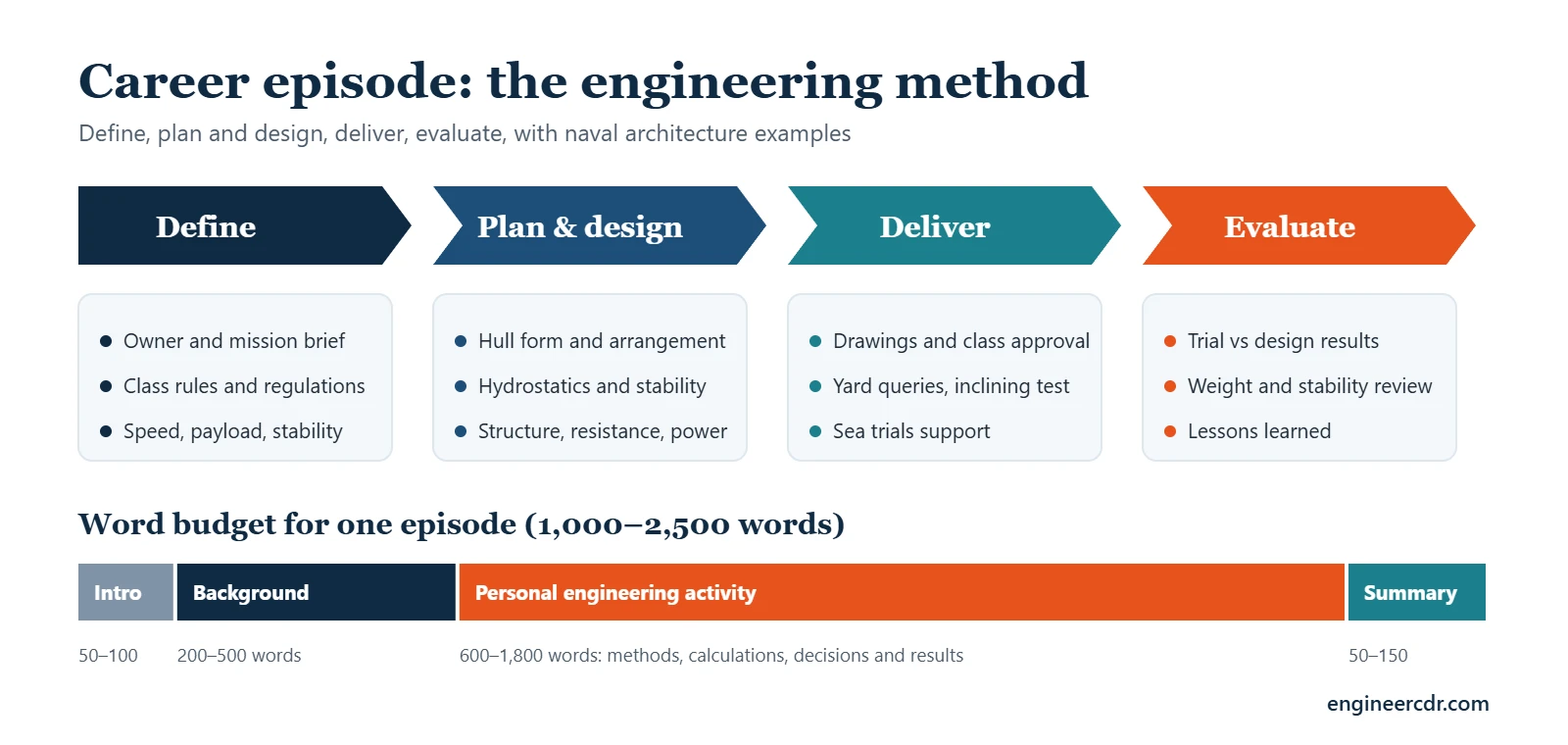
Engineers Australia asks you to follow the engineering method of defining, planning and designing, delivering and evaluating. A clear four-part layout works well:
| Section | Approximate length | What to cover |
|---|---|---|
| Introduction | 50 to 100 words | Project title, dates, location, organisation, your position |
| Background | 200 to 500 words | Vessel type, owner requirements, scope, class society, applicable rules, your team and your role |
| Personal engineering activity | 600 to 1,800 words | What you did: hull modelling, calculations, software, class rules checks, decisions, problems solved and results |
| Summary | 50 to 150 words | Outcome, what you delivered and what you learned |
Write in the first person (“I analysed”, not “we analysed”), number every paragraph, and spend most of the word count on the personal engineering activity.
Illustrative excerpt (fictional, for structure only)
This short example is invented to show tone and level of detail. Do not copy it; your episodes must describe your own work.
CE 2.5 I built a hull model of the workboat in Maxsurf from the lines plan and calculated the hydrostatics and cross curves for the lightship and four loading conditions. With the new deck crane added, the fully loaded departure condition no longer met the minimum metacentric height required by the stability criteria.
CE 2.6 I evaluated two options, a lower crane pedestal and permanent ballast in the double bottom. I recalculated the righting lever curves for both options against the IMO Intact Stability Code criteria and recommended the ballast option because it met all criteria with less impact on deadweight. I then prepared the inclining experiment procedure and submitted the revised stability calculations to the class surveyor.
How the summary statement maps competencies
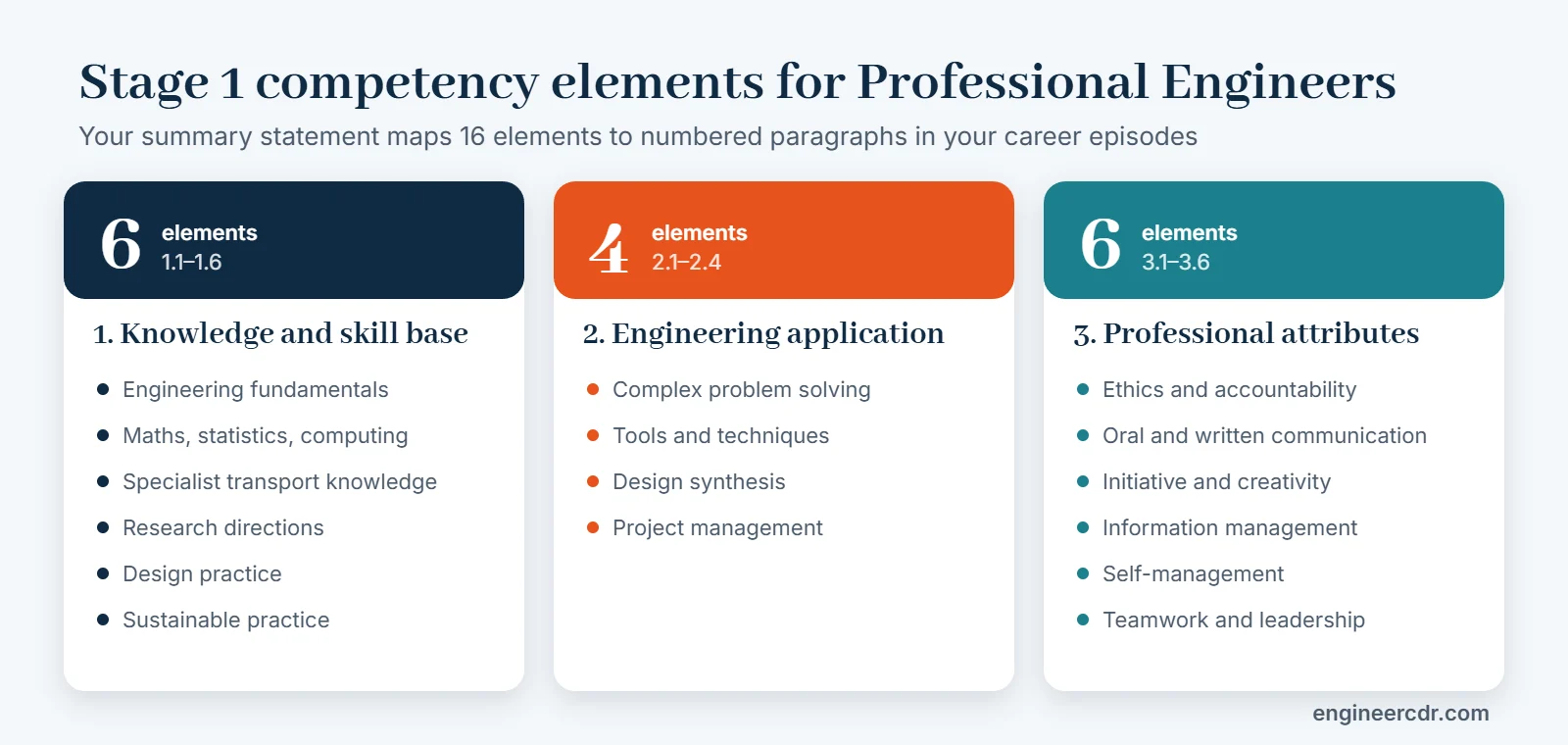
The summary statement is a table. For each of the 16 elements of the Stage 1 Competency Standard, you quote the paragraph numbers from your episodes where you demonstrated it. The elements fall into three areas:
| Area | Elements | Naval architecture evidence |
|---|---|---|
| 1. Knowledge and skill base | 1.1 to 1.6 | Hydrostatics and stability theory, ship structures, resistance and propulsion, design practice, sustainability |
| 2. Engineering application ability | 2.1 to 2.4 | Problem solving, Maxsurf, NAPA or FEA tools, vessel design synthesis, project and class approval management |
| 3. Professional and personal attributes | 3.1 to 3.6 | Safety and ethics, communication with owners, yards and class, initiative, records, self-management, teamwork |
Use the official Engineers Australia summary statement template for the Professional Engineer category and make sure every element is covered at least once across your three episodes. Our summary statement guidance explains the mapping in more detail.
CPD examples for Naval Architects
| Activity type | Examples |
|---|---|
| Formal courses | Stability, ship structures, FEA or project management courses |
| Software training | Maxsurf, NAPA, Rhino, AutoCAD, ShipConstructor, ANSYS or OrcaFlex |
| Seminars and conferences | Royal Institution of Naval Architects (RINA) events, class society seminars, maritime conferences and webinars |
| Standards and self-study | SOLAS, MARPOL, the IMO Intact Stability Code, classification rules and national vessel standards |
| On-the-job learning | Sea trials, inclining experiments, yard visits and design reviews, documented with dates and outcomes |
Common reasons a Naval Architecture CDR is rejected
- Copied or ghost-written content that fails Engineers Australia’s plagiarism checks
- Using “we” so your personal contribution is unclear
- Episodes that describe drafting tasks without your own calculations or design decisions
- Naming rules and software without explaining how you applied them
- Missing competency elements or wrong paragraph references in the summary statement
- Episodes shorter than 1,000 words or far above 2,500 words
- Dates, employers or project names that do not match your CV
How to write your Naval Architecture CDR, step by step
- Download the current Engineers Australia migration skills assessment booklet and competency templates.
- Confirm that ANZSCO 233916 matches most of your duties, compared with Mechanical or Structural Engineer.
- List your projects and choose three with clear personal engineering work.
- Collect the calculations, rules, drawings, software outputs and trial results for each project.
- Draft each episode in four sections, in the first person, with numbered paragraphs.
- Complete the summary statement by mapping each competency element to paragraph numbers.
- Prepare the CPD statement and a CV that matches your episodes, then review for originality and consistency.
Frequently asked questions
How many career episodes do I need for a Naval Architect CDR?
You need three career episodes. Each should be between 1,000 and 2,500 words, written in English in the first person, with numbered paragraphs.
Can I copy a CDR sample for naval architecture?
No. Engineers Australia treats copied work, or work written by another person, as plagiarism. The consequences include rejection and a reapplication ban of 12, 24 or 36 months. Use samples only to understand structure.
Which authority assesses ANZSCO 233916 Naval Architect?
Engineers Australia assesses the Naval Architect occupation for migration skills assessment purposes, against the Stage 1 Competency Standard for Professional Engineers.
What projects work best for a Naval Architect CDR?
Projects where you made design decisions and did the calculations yourself, such as hull design, stability, structural design to class rules, resistance and powering, or a vessel conversion.
Can shipyard production work be used as a career episode?
Yes, if the episode shows engineering work such as resolving design problems, weight and stability control or class approval. Supervision of routine fabrication alone will not demonstrate professional engineer competencies.
What should a Naval Architect include in CPD?
Include courses, software training, class society and RINA seminars, reading of rules and codes such as SOLAS and the IMO Intact Stability Code, and on-the-job learning, with dates and what you learned.
Is Naval Architect on the skilled occupation list?
Naval Architect (233916) has been listed on Australia’s Core Skills Occupation List, but lists change. Check the Department of Home Affairs website and your visa subclass before you apply.
How long should a career episode be?
Between 1,000 and 2,500 words. Most of the text should explain the engineering work you personally did, including methods, calculations, decisions and results.
Get your Naval Architecture CDR reviewed
Engineer CDR provides CDR review, editing and plagiarism checking and summary statement guidance, so your own draft is clear, consistent and competency-mapped. For service details, see our CDR for Naval Architects (ANZSCO 233916) page, or email info@engineercdr.com.
Want a second pair of eyes on your CDR?
Send us your own draft for review, editing and a plagiarism check against Engineers Australia’s requirements.
Related CDR samples and guides
- CDR sample for Mechanical Engineering (233512)
- CDR sample for Structural Engineering (233214)
- CDR sample for Production or Plant Engineer (233513)
- CDR report samples and structure guide
Source: Engineers Australia, Prepare your Migration Skills Assessment application. Requirements can change, so always check the current booklet.
