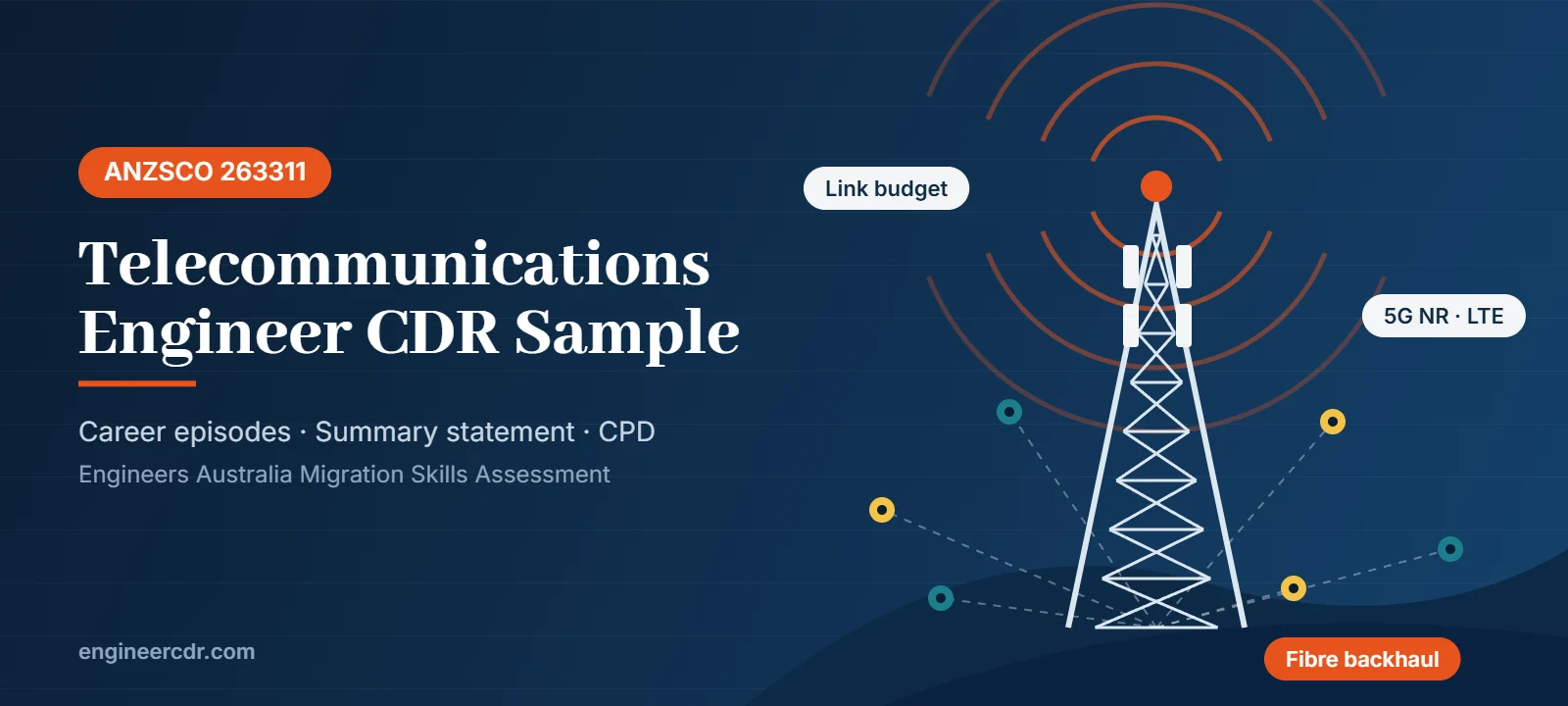
A CDR sample for a telecommunications engineer shows how to structure the three career episodes, summary statement and CPD list that Engineers Australia assesses for ANZSCO 263311 (Telecommunications Engineer). This guide explains each part of the report, with project ideas from 5G, LTE, microwave and fibre work, competency mapping, an illustrative excerpt and answers to the questions applicants ask most. Last updated: October 2026.
Write it yourself. Engineers Australia requires your career episodes and summary statement to be your own work. Copying a sample, or having another person or company write them, counts as plagiarism and can lead to rejection and a 12, 24 or 36 month reapplication ban. Use this page to learn the structure and level of detail, then write from your own projects.
Telecommunications Engineer (ANZSCO 263311) at a glance
| Item | Detail |
|---|---|
| Occupation | Telecommunications Engineer |
| ANZSCO code | 263311 (unit group 2633, Telecommunications Engineering Professionals) |
| Assessing authority | Engineers Australia (Migration Skills Assessment) |
| Skill level | ANZSCO skill level 1 |
| Competency standard | Stage 1 Competency Standard for Professional Engineer (16 elements of competency) |
| Core documents | CV, three career episodes, summary statement, CPD statement, ID, qualifications and English language evidence |
| Career episode length | 1,000 to 2,500 words each, first person, numbered paragraphs |
| Closely related code | 263312 Telecommunications Network Engineer |
What is a CDR for a Telecommunications Engineer?
A Competency Demonstration Report (CDR) is the evidence Engineers Australia uses to decide whether your qualifications and experience match the occupation you nominate. For ANZSCO 263311, the assessor wants proof that you designed, built, configured, commissioned or analysed telecommunications systems at professional engineer level, not that you simply operated them.
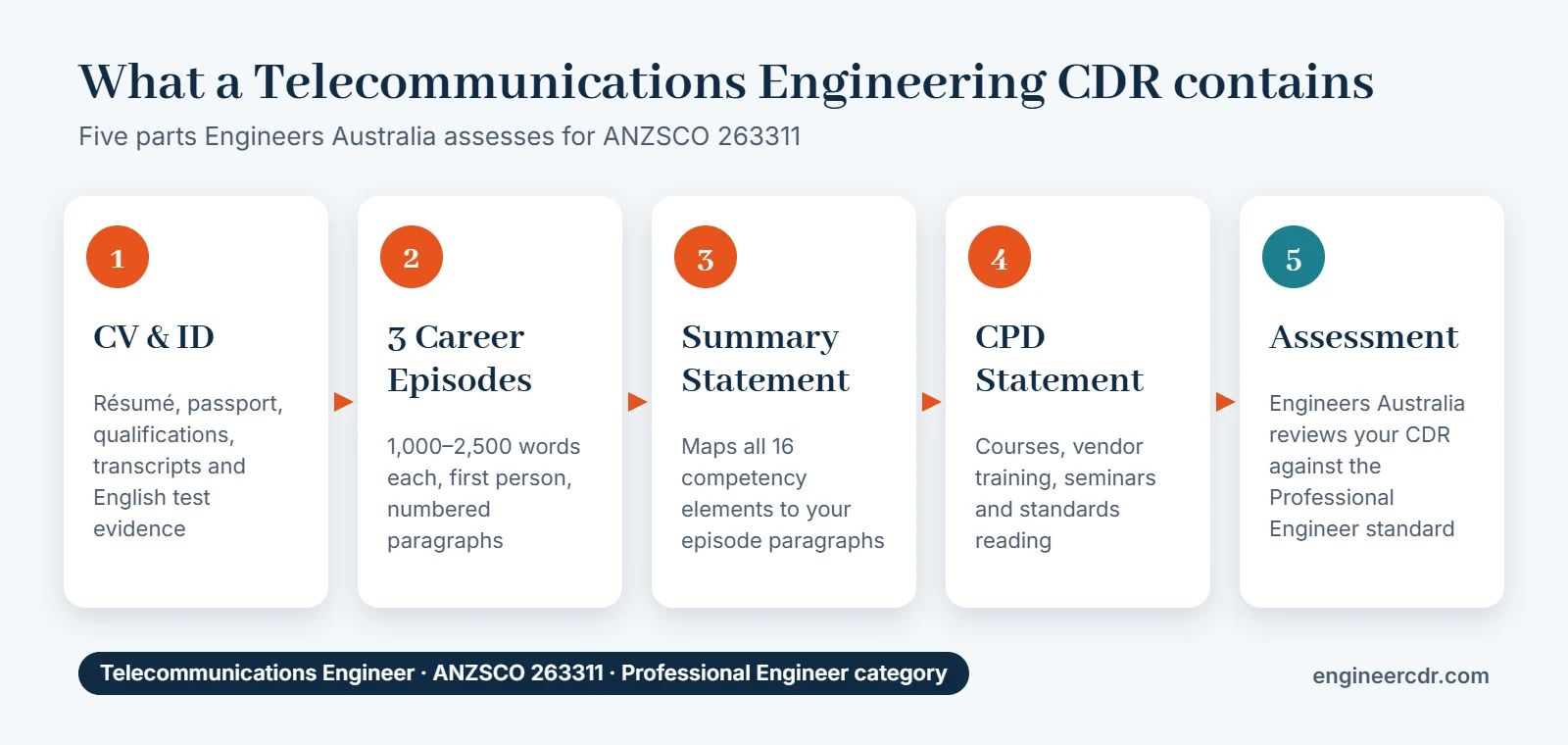
The technical part of the CDR has three documents: three career episodes that describe your engineering work, a summary statement that maps your episodes to each competency element, and a CPD statement that lists your continuing professional development.
What does a Telecommunications Engineer do?
ANZSCO describes telecommunications engineers as professionals who design, construct, install, service and support telecommunications equipment, systems and facilities. Typical tasks you can draw on for your episodes include:
- Planning, designing, building, configuring and commissioning voice, radio, data, microwave and satellite systems
- Preparing engineering proposals with goals, scope, background and cost
- Evaluating and procuring products and services from vendors
- Making sure systems comply with laws, regulations and technical standards
- Selecting telecom sites and preparing approval documents and construction drawings
- Choosing hardware and software configurations that meet performance targets
- Analysing interference, coverage and quality problems and recommending fixes
- Monitoring performance and planning upgrades and preventive maintenance
What a Telecommunications Engineering CDR contains
| Component | What Engineers Australia expects | Tip for telecom engineers |
|---|---|---|
| Career Episode 1 | An engineering activity or project, 1,000 to 2,500 words, first person | Choose your strongest design or optimisation project |
| Career Episode 2 | A different activity showing other competencies | Show a different skill, for example radio planning versus fibre design |
| Career Episode 3 | A third activity; may be study-based for recent graduates | Cover project management, procurement or troubleshooting |
| Summary statement | Maps every competency element to numbered episode paragraphs | Cross-reference paragraph numbers exactly |
| CPD statement | Written evidence of continuing professional development | List vendor certifications, courses, seminars and standards reading |
| CV and documents | Résumé, qualifications, transcripts, ID, English test evidence | Keep project names, dates and employers consistent with your episodes |
Career episode ideas for Telecommunications Engineers
Choose projects where you made the engineering decisions. Strong options include:
- 4G/5G radio network planning: coverage and capacity prediction, site selection, parameter design and post-launch optimisation.
- Microwave backhaul link design: path profile, Fresnel clearance, link budget, fade margin and availability calculation.
- Fibre network design (FTTH/GPON): optical power budget, splitter design, route planning and acceptance testing.
- Drive-test analysis and KPI optimisation: throughput, latency, handover and interference troubleshooting.
- Core and IP network design: MPLS, VoLTE/IMS or SD-WAN configuration, redundancy and capacity planning.
- Enterprise Wi-Fi or in-building coverage: site survey, access point placement, capacity and roaming design.
- Satellite or VSAT link design: link budget, antenna sizing and availability analysis.
- IoT or LoRaWAN deployment: gateway placement, coverage testing and device connectivity.
- Antenna or RF circuit design: simulation, prototyping and measurement, often suitable for final-year projects.
- Site acquisition and compliance: approvals, construction drawings and electromagnetic exposure checks.
Standards and tools you can reference
Naming the standards, tools and calculations you actually used makes an episode credible. The table shows examples; only include what you personally worked with.
| Area | Standards and references | Common tools |
|---|---|---|
| Mobile networks (LTE, 5G NR) | 3GPP specifications (for example the 36 and 38 series) | Atoll, Planet, iBwave, TEMS, Nemo |
| Microwave links | ITU-R recommendations on line-of-sight link propagation, such as P.530 | Pathloss, vendor link planning tools |
| Optical fibre | ITU-T recommendations for single-mode fibre and PON systems, such as G.652 and G.984 | OTDR, optical power meters, GIS tools |
| Wireless LAN | IEEE 802.11 family | Ekahau, vendor controllers, spectrum analysers |
| IP and core networks | IETF RFCs, vendor design guides | Wireshark, router and switch CLIs, network simulators |
| Antenna and RF design | IEEE antenna and measurement practice | MATLAB, CST, HFSS, vector network analyser |
| Regulation and safety | National spectrum rules, ICNIRP exposure guidelines | Compliance calculators, site audit forms |
How to structure each career episode
Engineers Australia asks you to follow the engineering method of defining, planning and designing, delivering and evaluating. A four-part layout works well:
| Section | Approximate length | What to cover |
|---|---|---|
| Introduction | 50 to 100 words | Project title, dates, location, organisation, your position |
| Background | 200 to 500 words | Purpose, scope, network or site, stakeholders, standards, your role |
| Personal engineering activity | 600 to 1,800 words | What you did: calculations, design choices, tools, tests, problems solved and results |
| Summary | 50 to 150 words | Outcome, what you delivered and what you learned |
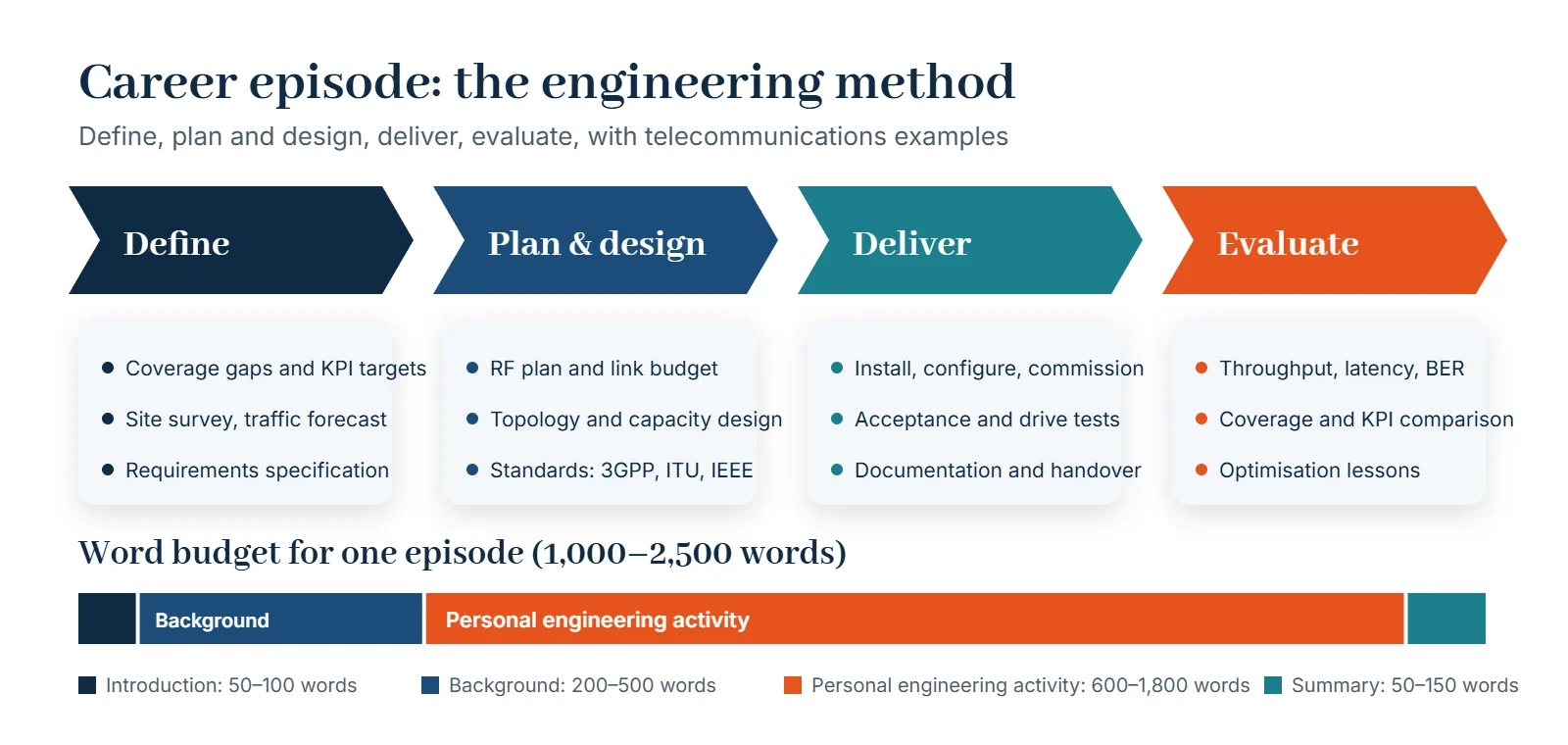
Write in the first person (“I calculated”, not “we calculated”), number every paragraph, and spend most of the word count on your personal engineering activity.
Illustrative excerpt (fictional, for structure only)
This short example is invented to show tone and level of detail. Do not copy it; your episodes must describe your own work.
CE 2.5 I extracted the terrain profile for the proposed microwave hop and checked line-of-sight clearance against the first Fresnel zone. The far-end obstruction reduced clearance, so I recommended raising the antenna mount and re-ran the profile.
CE 2.6 I then built the link budget by adding transmit power and antenna gains and subtracting free-space loss and feeder losses. I compared the received level with the receiver threshold to confirm a fade margin that met the availability target, and documented the result for the design review.
How the summary statement maps competencies
The summary statement is a table. For each of the 16 elements of the Stage 1 Competency Standard you quote the numbered paragraphs where you demonstrated it. The elements fall into three areas:
| Area | Elements | Telecommunications evidence |
|---|---|---|
| 1. Knowledge and skill base | 1.1 to 1.6 | Signal theory, RF and optical fundamentals, mathematics and statistics, specialist telecom knowledge, design practice, sustainability |
| 2. Engineering application ability | 2.1 to 2.4 | Fault and interference analysis, planning and simulation tools, network design synthesis, project management |
| 3. Professional and personal attributes | 3.1 to 3.6 | Ethics, vendor and client communication, initiative, documentation, self-management, teamwork |
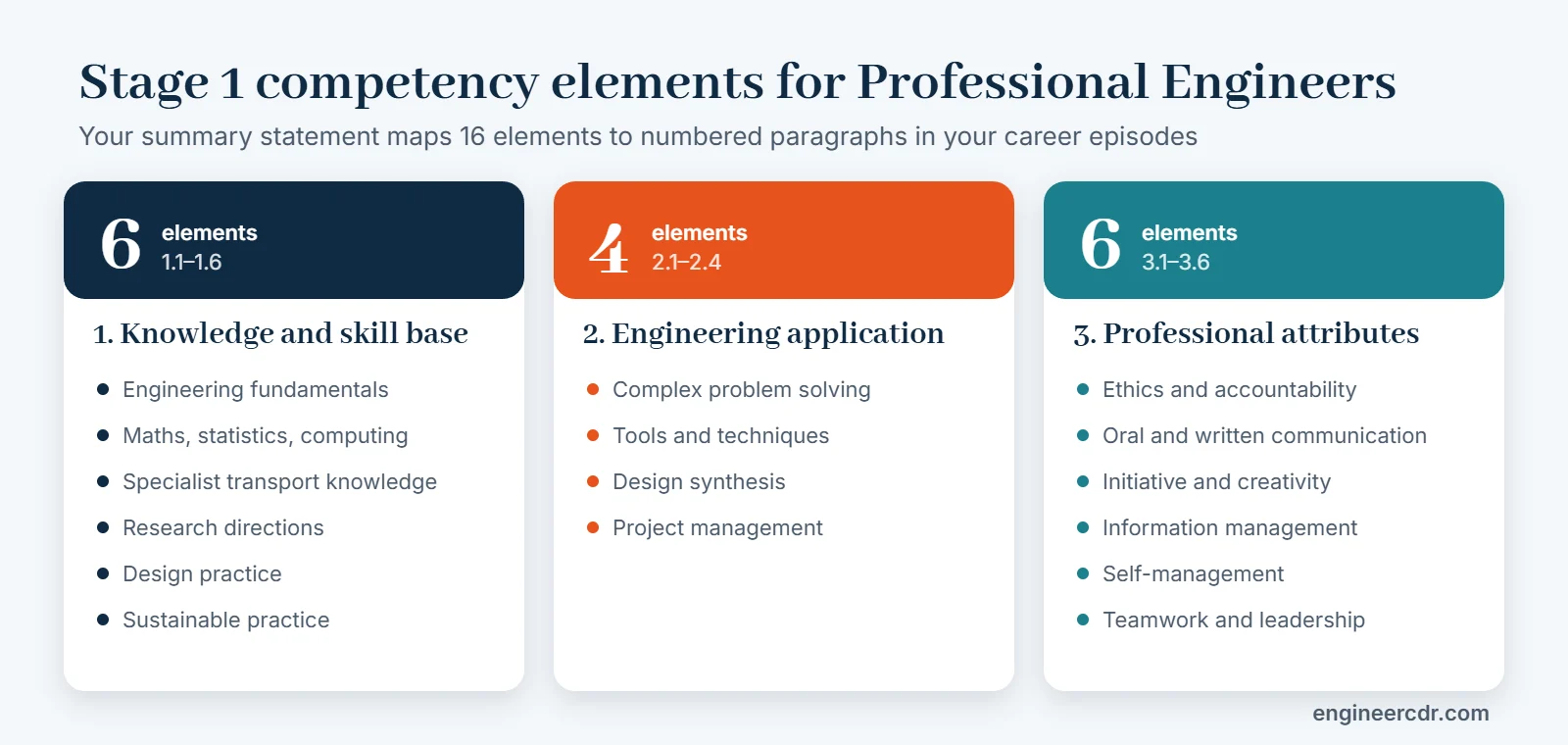
Use the official Engineers Australia template for the Professional Engineer category and make sure every element is demonstrated at least once across your three episodes.
CPD examples for Telecommunications Engineers
| Activity type | Examples |
|---|---|
| Vendor and industry training | Cisco, Juniper, Huawei, Ericsson or Nokia courses and certifications |
| Technical courses | 5G fundamentals, RF planning, fibre splicing and testing, network security |
| Software training | Planning, simulation and drive-test tools such as Atoll, iBwave or MATLAB |
| Seminars and conferences | Telecommunications and wireless conferences, webinars and professional society events |
| Standards and self-study | Reading 3GPP, ITU and IEEE documents relevant to your projects |
| On-the-job learning | Design reviews, mentoring, site commissioning and fault-finding experience, with dates and outcomes |
Common reasons a Telecommunications CDR is rejected
- Copied or ghost-written content that fails Engineers Australia’s plagiarism checks
- Using “we” so your personal contribution is unclear
- Listing network tasks without the calculations, design choices and results behind them
- Describing operations or support work with no engineering design or analysis
- Missing competency elements or wrong paragraph references in the summary statement
- Episodes shorter than 1,000 words or far above 2,500 words
- Dates, employers or project titles that do not match your CV
- Generic text that names no standards, tools, measurements or outcomes
How to write your Telecommunications CDR, step by step
- Download the current Engineers Australia migration skills assessment booklet and competency templates.
- List your projects and pick three with clear personal engineering design or analysis work.
- Collect the calculations, configurations, test results, standards and tools for each project.
- Draft each episode in four sections, first person, with numbered paragraphs.
- Complete the summary statement by mapping each competency element to paragraph numbers.
- Prepare the CPD statement and a CV that matches your episodes.
- Review for originality, consistency, technical accuracy and grammar before you submit.
Frequently asked questions
How many career episodes do I need for a Telecommunications Engineer CDR?
You need three career episodes. Each should be between 1,000 and 2,500 words, written in English in the first person.
Can I copy a CDR sample for telecommunications engineering?
No. Engineers Australia treats copied work, or work written by another person, as plagiarism. The consequences include rejection and a reapplication ban of 12, 24 or 36 months. Use samples only to understand structure.
Which authority assesses ANZSCO 263311?
Engineers Australia assesses the Telecommunications Engineer occupation for migration skills assessment purposes.
What is the difference between ANZSCO 263311 and 263312?
263311 Telecommunications Engineer focuses on designing and developing telecommunications systems, devices and products, while 263312 Telecommunications Network Engineer focuses on networks. Choose the code whose tasks best match the work you have actually done.
Which projects suit a telecommunications engineering career episode?
Good options include 4G/5G radio planning, microwave link design, fibre network design, drive-test optimisation, core network configuration and antenna design, as long as you personally did the engineering work.
Can I use a final-year project as a career episode?
Yes, if you are a recent graduate. Engineers Australia allows study-based projects. For group projects, describe only your personal contribution.
What should a Telecommunications Engineer include in CPD?
Include vendor training, technical courses, software training, seminars, conferences, standards reading and on-the-job learning, with dates and what you learned.
Is Telecommunications Engineer on the skilled occupation list?
Occupation lists and visa eligibility change. Check the Department of Home Affairs website and your chosen visa subclass before you apply.
Get your Telecommunications CDR reviewed
Engineer CDR provides CDR review, editing and plagiarism checking and summary statement guidance, so your own draft is clear, consistent and competency-mapped. For service details, see our CDR for Telecommunications Engineers (ANZSCO 263311) page, or email info@engineercdr.com.
Want a second pair of eyes on your CDR?
Send us your own draft for review, editing and a plagiarism check against Engineers Australia’s requirements.
Related CDR samples and guides
- CDR sample for Electrical Engineering (233311)
- CDR sample for Electronics Engineering (233411)
- CDR for Telecommunications Network Engineers (263312)
- CDR report samples and structure guide
Sources: Engineers Australia, Prepare your Migration Skills Assessment application; ANZSCO 263311 occupation description. Requirements can change, so always check the current booklet.
