CDR for Aeronautical Engineers (ANZSCO 233911) is the Competency Demonstration Report you submit to Engineers Australia to prove your engineering skills for Australian skilled migration. Engineer CDR helps aeronautical engineers prepare a clear, compliant report through draft review, editing, competency mapping and plagiarism checks, while the career episodes stay your own work. Last updated: October 2026.
What is ANZSCO 233911 Aeronautical Engineer?
ANZSCO 233911 Aeronautical Engineer is the occupation for professional engineers who design, analyse, test and maintain the airworthiness of aircraft, aircraft systems and components. It sits in the Other Engineering Professionals group, and Engineers Australia is the assessing authority for migration skills assessment.
| Item | Detail |
|---|---|
| Occupation | Aeronautical Engineer |
| ANZSCO code | 233911 |
| Assessing authority | Engineers Australia (Migration Skills Assessment) |
| Assessment category | Professional Engineer |
| Typical qualification | Bachelor degree in aeronautical, aerospace or mechanical engineering with an aeronautical focus |
| Related occupations | Mechanical Engineer (233512), Engineering Technologist (233914) |
Typical duties assessed under this code include:
- Designing and analysing aircraft structures and components
- Aerodynamic analysis, wind tunnel testing and CFD
- Propulsion system integration and performance analysis
- Flight mechanics, stability, control and performance studies
- Airworthiness certification and compliance with aviation regulations
- Maintenance engineering, modifications and repair design
- Reliability, fatigue and damage tolerance assessment
- Testing, instrumentation and flight test support
Who needs a CDR as an Aeronautical Engineer?
You need a CDR if your engineering degree is not accredited by Engineers Australia and is not covered by the Washington Accord, or if you are not eligible for another assessment pathway. Graduates of Washington Accord accredited programmes can usually apply through the accredited qualification pathway instead. The CDR lets Engineers Australia judge your skills against the Stage 1 Competency Standard for Professional Engineers.
Australian visa pathways for Aeronautical Engineers
A positive skills assessment is a key step for most skilled and employer-sponsored visas. Common options for aeronautical engineers include:
| Visa | Type | Notes |
|---|---|---|
| Subclass 189 | Skilled Independent | Points-tested, no sponsor needed |
| Subclass 190 | Skilled Nominated | Requires state or territory nomination |
| Subclass 491 | Skilled Work Regional (Provisional) | State nomination or eligible family sponsorship, regional area |
| Subclass 482 | Skills in Demand (employer sponsored) | Requires an approved employer sponsor |
| Subclass 186 | Employer Nomination Scheme | Permanent employer-sponsored visa |
Occupation lists, invitation rounds and state nomination criteria change often. Always check the Department of Home Affairs website and the relevant state migration website before you apply. Engineer CDR helps with the CDR only, not migration advice; for visa advice, speak to a registered migration agent.
How Engineer CDR helps Aeronautical Engineers
Your work, your words. Engineers Australia requires career episodes and the summary statement to be written by you about your own work. Reports written by someone else can be rejected and lead to a reapplication ban. Our support is built around your own draft: we review, explain and improve, and you stay the author.
CDR review
A detailed review of your CV, career episodes, summary statement and CPD against Engineers Australia requirements.
Editing and feedback
Line-by-line feedback on structure, first-person writing, clarity and the technical detail assessors look for.
Summary statement mapping
A check that every competency element is covered and referenced to the right paragraph numbers.
Plagiarism and consistency check
A similarity scan and a check that dates, employers and projects match across all documents.
Project selection advice
Help choosing the three projects that best show your aeronautical engineering competencies.
Free sample and guidance
Our Aeronautical Engineer CDR sample shows the structure, with examples you can learn from.
Our CDR support process
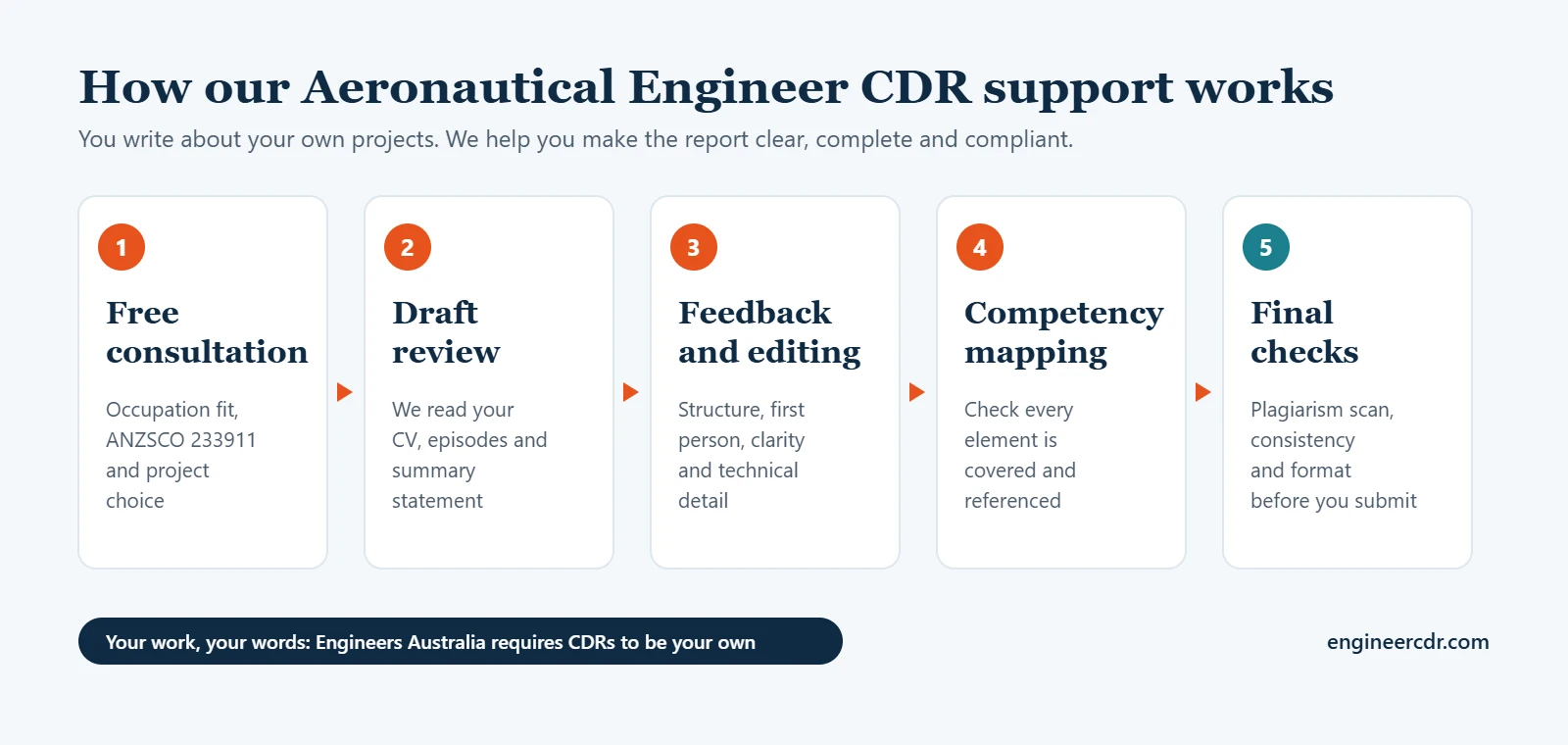
- Free consultation: we confirm that ANZSCO 233911 fits your qualifications and experience and discuss your projects.
- Draft review: you send your own CV, career episodes, summary statement and CPD list.
- Feedback and editing: we return detailed comments and edits; you revise in your own words.
- Competency mapping: we check every element is evidenced and correctly referenced.
- Final checks: plagiarism scan, consistency check and formatting before you submit to Engineers Australia.
CDR format for Aeronautical Engineers
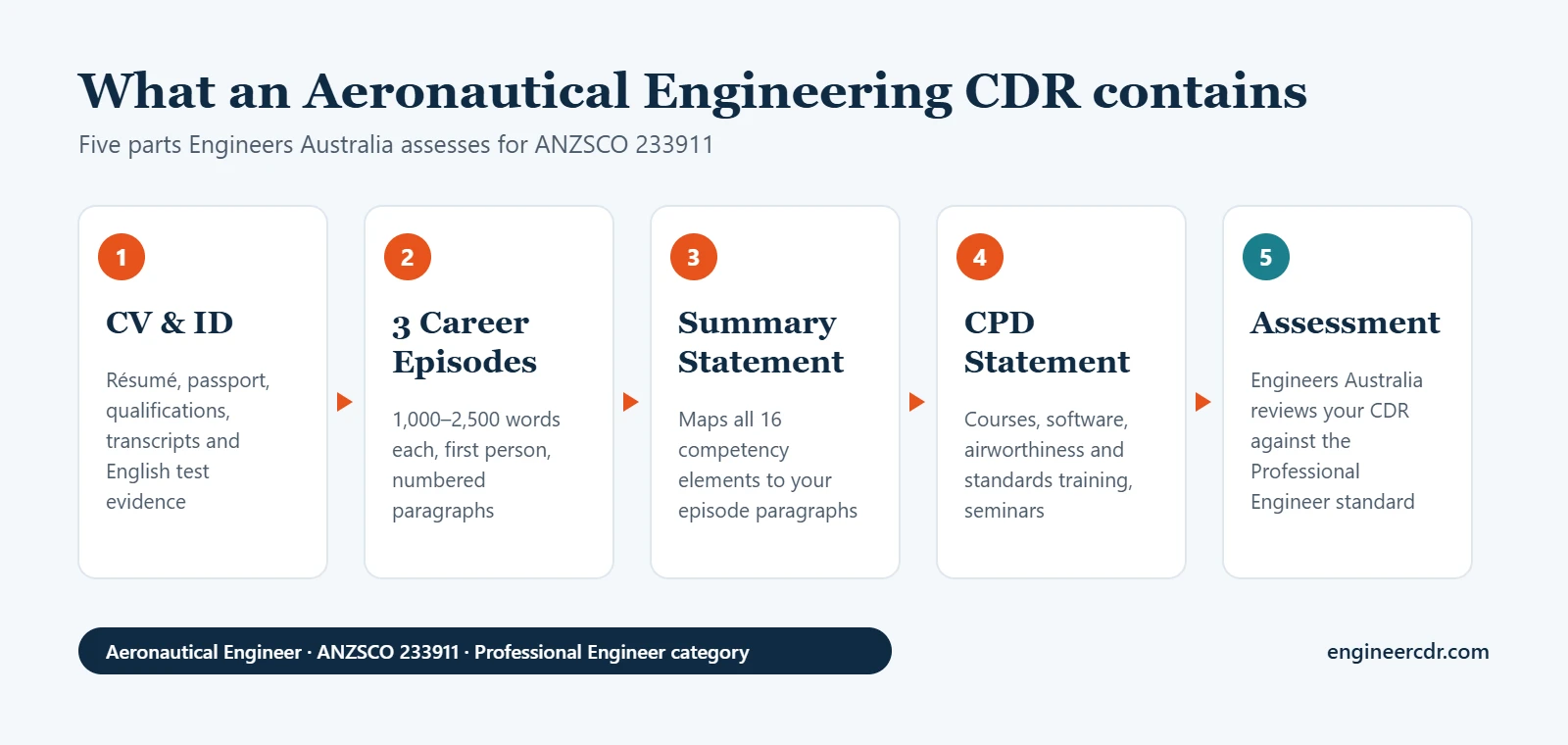
| Document | What Engineers Australia expects | Tip for aeronautical engineers |
|---|---|---|
| CV | Full work and education history with dates, employers and roles | Match project names and dates to your episodes |
| Three career episodes | 1,000 to 2,500 words each, first person, numbered paragraphs | Show your own analysis, calculations and airworthiness decisions |
| Summary statement | Maps each competency element to paragraph numbers | Reference exact paragraphs, not whole episodes |
| CPD statement | Continuing professional development, about one page | Include CATIA, ANSYS or NASTRAN training and airworthiness courses |
| Supporting documents | ID, qualifications, transcripts and English test evidence | Check names and dates are consistent |
Career episode ideas for Aeronautical Engineers
Strong episodes describe projects where you personally made engineering decisions. Ideas that often work well:
- Structural repair or modification design: load analysis, stress calculations and approval documentation.
- Aerodynamic study: CFD or wind tunnel analysis of an airfoil, wing or component.
- Fatigue and damage tolerance assessment: crack growth analysis and inspection intervals.
- Maintenance programme improvement: reliability data analysis and task interval changes.
- Avionics or systems integration: requirements, interface design, testing and certification.
- UAV or drone design: sizing, propulsion selection, structure and flight testing.
- Composite component design: layup design, analysis and manufacturing or repair process.
- Final-year project or thesis: suitable for recent graduates, describing your own contribution.
See our Aeronautical Engineer CDR sample for an episode structure, an illustrative excerpt and competency mapping.
Common reasons Aeronautical Engineer CDRs are rejected
- Copied, purchased or ghost-written content found by plagiarism checks
- Using “we” so your personal role is unclear
- Episodes describing licensed maintenance tasks rather than engineering analysis and design
- Listing software and regulations without explaining how you applied them
- Missing competency elements or wrong paragraph references
- Inconsistent dates, employers or project names across documents
- Episodes outside the 1,000 to 2,500 word range
Frequently asked questions
Who assesses Aeronautical Engineers (ANZSCO 233911) for migration?
Engineers Australia assesses Aeronautical Engineers. If your degree is not accredited or covered by the Washington Accord, you usually apply through the CDR pathway.
Do aircraft maintenance engineers use ANZSCO 233911?
Usually not. Licensed aircraft maintenance engineers are a separate trade occupation with a different assessing authority. ANZSCO 233911 is for professional engineers who design, analyse and certify aircraft and systems.
Can Engineer CDR write my CDR for me?
No. Engineers Australia requires your career episodes and summary statement to be your own work. We review, edit and check your own draft, explain what assessors look for and help you map the competencies.
How long should each career episode be?
Between 1,000 and 2,500 words, written in the first person with numbered paragraphs. Most of the text should explain the engineering work you personally did.
Can I use my university project as a career episode?
Yes, recent graduates can use study-based projects such as a final-year aircraft design or thesis, as long as you describe your own contribution clearly.
Is a positive skills assessment enough to get PR?
No. It is one step. You also need to meet the visa requirements, such as points, English, age and an invitation or nomination. Check the Department of Home Affairs website or speak to a registered migration agent.
How long does Engineers Australia take to assess a CDR?
Processing times vary through the year. Check the current timeframes on the Engineers Australia website; a fast track option is available for an extra fee.
Is Aeronautical Engineer on the skilled occupation list?
Aeronautical Engineer (233911) has been listed on Australia’s skilled occupation lists, but lists change. Check the Department of Home Affairs website and your visa subclass before you apply.
Get help with your Aeronautical Engineer CDR
Send us your draft or book a free consultation. Email info@engineercdr.com and tell us your occupation, your projects and when you plan to apply.
Ready for a second pair of eyes on your CDR?
Get a review, editing and plagiarism check of your own Aeronautical Engineer CDR against Engineers Australia’s requirements.
Related services and guides
- Aeronautical Engineer CDR sample
- CDR review, editing and plagiarism check
- Summary statement guidance
- Career episode guidance
- CDR for Mechanical Engineers (ANZSCO 233512)
Source: Engineers Australia, Prepare your Migration Skills Assessment application. Requirements can change, so always check the current booklet.
