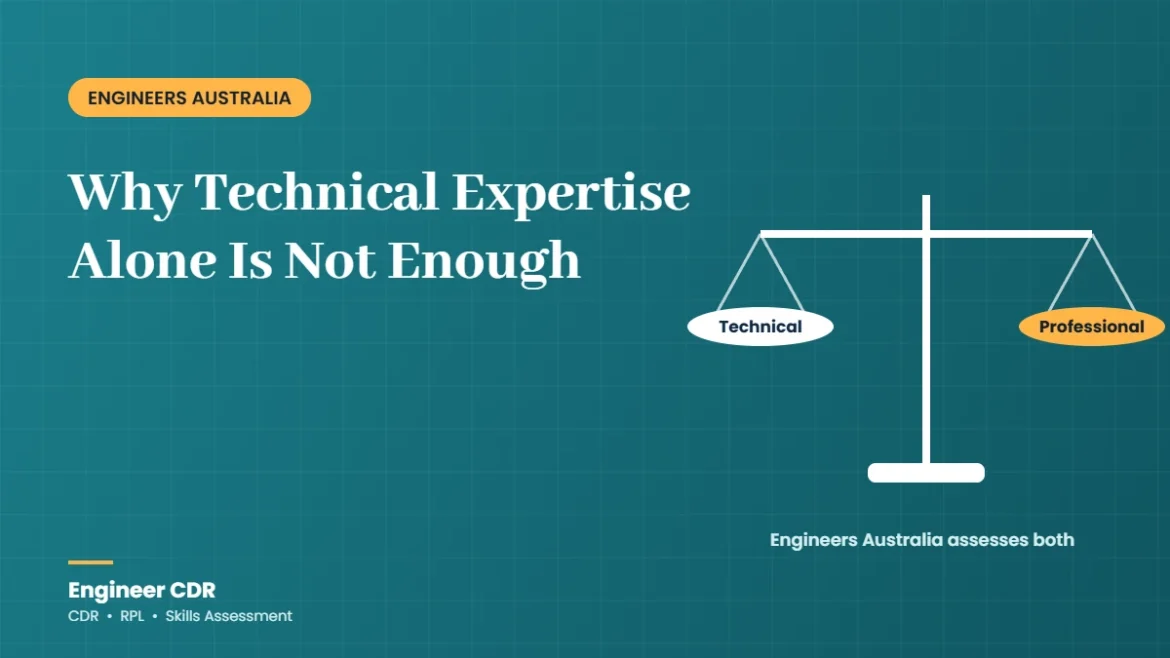
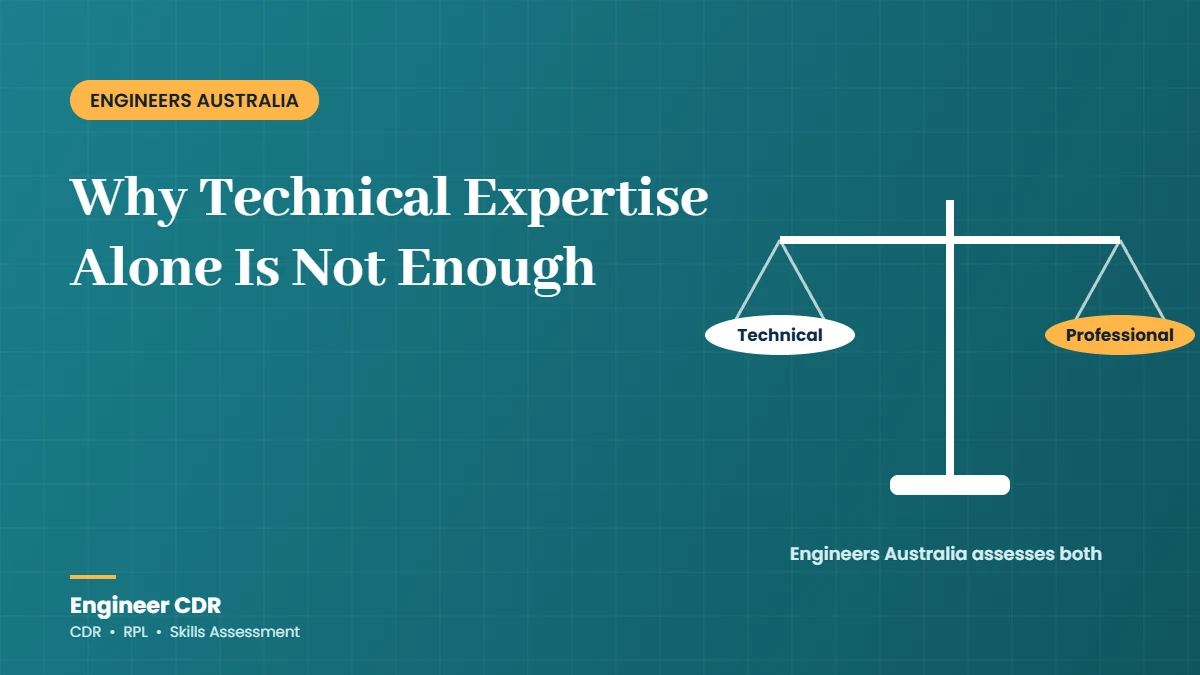
Many experienced engineers assume that deep technical knowledge will carry their Competency Demonstration Report (CDR). They have designed systems, solved difficult problems and worked with advanced tools for years. Yet some of these engineers are surprised when their CDR is questioned or rejected. The reason is simple: Engineers Australia does not assess technical expertise on its own. It assesses whether you can apply that expertise as a competent, responsible professional engineer.
Short answer
Engineers Australia’s competency standards cover three areas: knowledge and skill base, engineering application ability and professional and personal attributes. A CDR that shows only technical skill leaves out communication, ethics, teamwork, safety and ongoing learning, which assessors also need to see.
What Engineers Australia actually assesses
Engineers Australia assesses CDR applicants against its competency standards for the occupational category you apply for, such as Professional Engineer, Engineering Technologist or Engineering Associate. These standards group competencies into three broad areas:
| Competency area | What it covers |
|---|---|
| Knowledge and skill base | Your understanding of engineering fundamentals, specialist knowledge and the context in which engineering is practised |
| Engineering application ability | How you apply that knowledge: problem-solving, design, using engineering methods and tools, and managing projects |
| Professional and personal attributes | Ethics, communication, creativity, information use, self-management, teamwork and professional responsibility |
Technical expertise mainly supports the first two areas. The third area is where many otherwise strong CDRs lose ground, because it is easy to assume that professional attributes are “obvious” and do not need to be shown.
The competencies beyond technical skill
Communication
Engineers explain designs to clients, coordinate with contractors, write reports and present recommendations. Assessors want to see how you communicated technical information to different audiences, not just that you produced calculations.
Ethics and professional responsibility
Professional engineers make decisions that affect safety, public welfare and the environment. Describing a moment when you raised a concern, refused to cut a corner or followed a standard even under pressure shows professional responsibility in a way technical detail cannot.
Teamwork and leadership
Most engineering work happens in teams. A strong CDR shows how you worked with others while keeping your own contribution clear, for example by coordinating disciplines, mentoring junior staff or resolving a disagreement about a design approach.
Safety, risk and sustainability
Identifying hazards, assessing risks and considering environmental and social impacts are part of competent engineering practice. Mentioning relevant standards and the steps you took to manage risk strengthens your evidence.
Continuing professional development
Your CPD list shows that you keep your knowledge current. Courses, training, conferences and self-directed learning all help demonstrate that you take responsibility for your own development.
Where technically strong CDRs fall short
- Report-style writing. The Career Episode reads like a technical report, full of specifications but with little about the engineer’s decisions or role.
- “We” instead of “I”. Team achievements are described without making personal contribution clear.
- Missing professional attributes. Communication, ethics and teamwork are never mentioned, so the assessor cannot map them to the competencies.
- Occupation mismatch. Technically impressive work that belongs to a different discipline does not support the nominated occupation.
- Weak Summary Statement. The summary does not point clearly to the paragraphs that show each competency element.
How to show the full picture
You do not need extraordinary projects to demonstrate professional competency. You need to show how you worked as an engineer. When planning each Career Episode, ask yourself:
- What problem did I personally have to solve, and what options did I consider?
- How did I communicate my findings and to whom?
- What standards, safety requirements or ethical considerations shaped my decisions?
- How did I work with others while keeping my own responsibilities clear?
- What did I learn, and how has it shaped my later work?
Then make sure your Summary Statement links each competency element to the specific paragraph where you demonstrate it, and that your Career Episodes are written in your own words and in the first person.
Technical expertise shows what you know. Professional competency shows how you use it. A strong CDR needs both.
Final thoughts
Technical skill is the foundation of every engineering career, but Engineers Australia is looking for a complete professional engineer. When your CDR shows how you communicate, make responsible decisions, manage risk, work with others and keep learning, your technical expertise becomes far more convincing. For a closer look at how assessors read your experience, see why some engineers get positive assessments faster.
Frequently asked questions
Is technical knowledge important for a CDR?
Yes. It forms the foundation of your Career Episodes, but Engineers Australia also assesses how you apply that knowledge and your professional and personal attributes.
Which professional skills should a CDR show?
Communication, ethical decision-making, teamwork, safety and risk awareness, project and self-management, and ongoing professional development are all areas assessors look for.
How do I show ethics and communication in a Career Episode?
Describe specific situations, such as explaining a design change to a client, raising a safety concern or coordinating with another discipline, and explain what you did and why.
How many competency elements are there for a Professional Engineer?
There are 16 elements in three groups: knowledge and skill base, engineering application ability, and professional and personal attributes.
What should I include in my CPD list?
Relevant courses, workshops, conferences, seminars and self-study since graduation, with the title, date, duration and organiser for each.
Can one career episode cover all competency elements?
Rarely. Spread your evidence across all three episodes so that, together, they cover every element, and use the summary statement to show where each one appears.
How do I show continuing professional development?
List relevant courses, workshops, conferences and self-study since graduation in your CPD list, and mention in your episodes how new learning improved your work.
Do I need to mention sustainability in my CDR?
If it is relevant to your work, yes. Considering energy use, materials, waste or environmental impact in your decisions is part of responsible engineering practice.
The competency standard at a glance
For the Professional Engineer category, Engineers Australia’s Stage 1 competency standard has 16 elements in three groups. Your career episodes should give evidence across all of them, and your summary statement should point to it.
| Group | What it covers | Example of evidence |
|---|---|---|
| Knowledge and skill base (PE1) | Science, maths, engineering fundamentals, specialist knowledge, research directions and the context of engineering practice | Explaining the analysis method you used and why it suited the problem |
| Engineering application ability (PE2) | Problem solving, using engineering methods and tools, and managing design and project processes | Describing how you identified a fault, tested options and chose a solution |
| Professional and personal attributes (PE3) | Ethics, communication, creativity, information use, self-management and teamwork | Showing how you raised a safety concern, presented findings or led a team task |
Sentences that show professional skills
- Communication: “I presented the revised load calculations to the client’s project team and answered their questions on the change in steel grade.”
- Ethics: “When I found the contractor had substituted a lower-rated cable, I stopped the installation and reported it to the project manager.”
- Teamwork: “I coordinated three technicians and assigned testing tasks based on their experience.”
- Risk and safety: “I prepared a hazard assessment for the confined-space work and added gas monitoring to the procedure.”
Each sentence names an action, gives context and shows judgement. Generic claims such as “I have excellent communication skills” do not count as evidence.
Make your CPD list work for you
The continuing professional development list shows how you have kept your knowledge current since graduating. List courses, workshops, conferences, seminars, self-study and professional reading with the title, date, duration and organiser. Choose activities relevant to your nominated occupation and present them clearly in a table; a short, relevant list is more convincing than a long, unfocused one.
Technologist and Associate categories
Engineering Technologists and Engineering Associates are assessed against their own competency standards, which emphasise applying established technologies and practical work rather than the research and complex design expected of Professional Engineers. Choosing the category that matches your real duties, and writing to its standard, often matters more than technical depth.
How Engineer CDR can help
Engineer CDR works with engineers preparing Engineers Australia migration skills assessments. Our team can help you:
- Map your projects to all 16 competency elements.
- Show communication, ethics, teamwork and safety with specific examples.
- Prepare a relevant, well-formatted CPD list.
- Choose the right occupational category for your experience.
We work from your real projects and responsibilities, so the final CDR reflects your own engineering experience and you can explain every part of it. Message us on WhatsApp or email info@engineercdr.com for a free initial assessment, or see our CDR review, editing and plagiarism check.
Where communication shows up in a CDR
Communication is not a separate section; it should appear naturally throughout your episodes. Writing reports, preparing drawings and specifications, presenting to clients, explaining technical changes to non-engineers and coordinating with contractors are all evidence. Mention who you communicated with, what you communicated and what changed as a result. The quality of your writing in the CDR itself is also evidence of your communication ability.
Showing ethics and accountability
Ethics evidence often comes from moments when you had to choose the right course of action under pressure: refusing to sign off unsafe work, reporting a non-compliance, protecting confidential client information or correcting your own mistake openly. Describe the situation briefly, the action you took and the outcome. One genuine, specific example is worth more than a paragraph of general statements about integrity.
A quick self-test for each career episode
- Can a reader tell exactly what you did, separate from your team?
- Is there at least one technical problem and your solution?
- Do you mention communication with others?
- Is there a safety, risk, quality or sustainability consideration?
- Does the summary explain what you achieved and learned?
If any answer is no, add a specific example before you finalise the episode.
Bringing it together
Technical expertise is the foundation of your CDR, but Engineers Australia assesses the whole engineer. The strongest applications combine solid technical detail with clear evidence of judgement, communication, ethics, teamwork and ongoing learning. When every career episode shows what you did, why you did it and how you worked with others, the assessor can see a competent professional, not just a skilled technician.
Example: one project, full picture
Imagine a mechanical engineer who redesigned a conveyor drive. A purely technical episode would describe the motor sizing and gearbox selection. A complete episode would also explain how the engineer consulted operators about jam problems, assessed the guarding and lock-out procedure, presented two options with costs to the plant manager, supervised installation with the maintenance team and reviewed downtime figures afterwards. The technical work is the same; the evidence of competence is far stronger.
Does your CDR show the whole engineer?
Get a review of your Career Episodes and Summary Statement against Engineers Australia’s competency requirements.

Leave a Reply