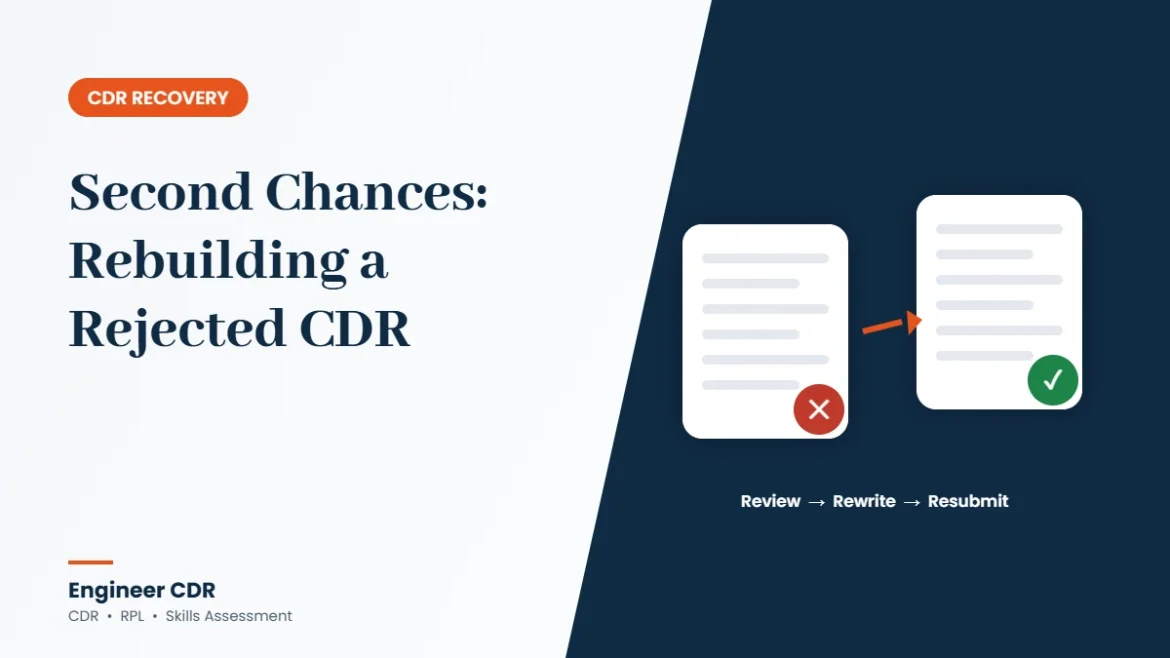
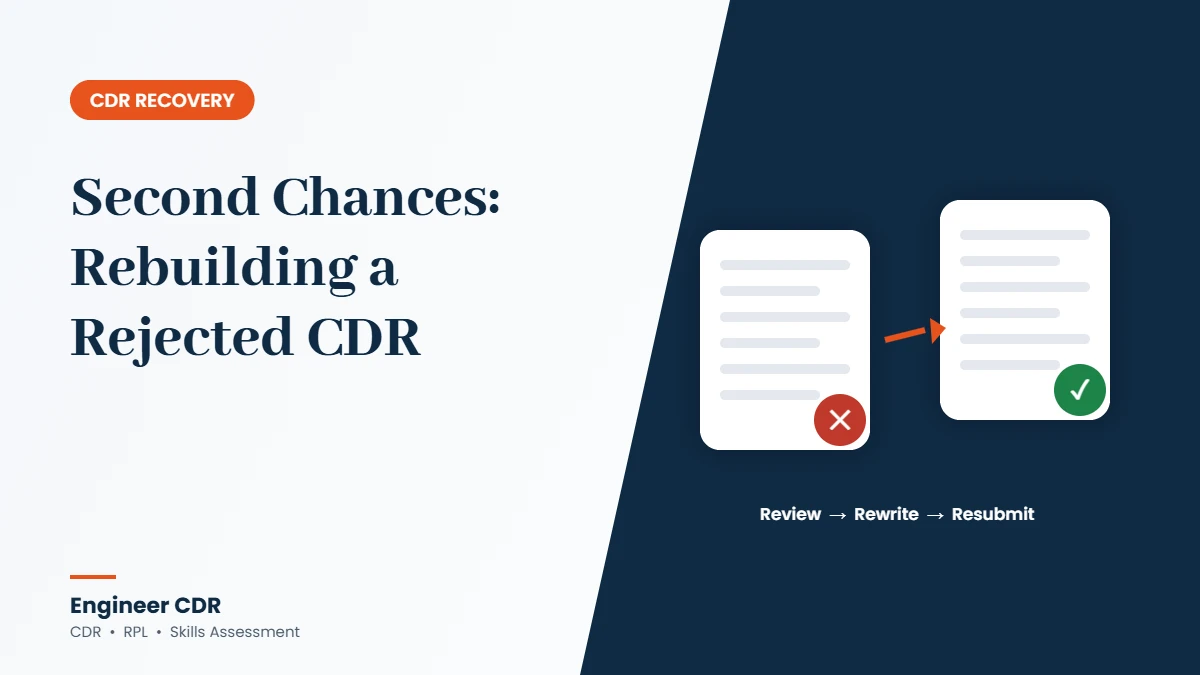
It is disappointing and stressful to receive a negative outcome on an Engineers Australia Competency Demonstration Report (CDR). Preparing the Career Episodes, Summary Statement and Continuing Professional Development (CPD) can take many engineers weeks or months, only to find that the report has not satisfied the assessment criteria. A failed CDR should not be the end of an engineering migration journey, though. It is often a chance to review the application, find its weaknesses and resubmit a stronger, more convincing one. Many engineers have gone on to receive a positive assessment after revising and resubmitting their CDRs.
Short answer
Start with the assessment feedback, compare your Career Episodes with the competency elements, then rewrite them with clear personal contribution, original wording and episodes that match your nominated occupation. Strengthen the Summary Statement so it points to that evidence.
Why CDRs are rejected
A lack of clearly demonstrated personal engineering competency is one of the most frequent reasons CDRs are rejected. Engineers Australia evaluates applicants on their individual contribution to a project, not on the project’s overall success. It is very common for applicants to describe their company’s successes, their team’s work or project results without clearly stating their own contribution.
Plagiarism is another major issue. Engineers Australia uses plagiarism detection to identify content that has been copied, heavily paraphrased or taken from templates or sample reports. Even if your experience is genuine, presenting it in borrowed wording or a copied format can lead to a negative outcome.
Poor alignment with the nominated occupation is another difficulty. For instance, a candidate applying as an Electrical Engineer must make sure that the Career Episodes are predominantly about electrical engineering activities. If the episodes focus too heavily on management tasks or other disciplines, the assessor may decide that the required competencies for the chosen occupation have not been shown.
| Common reason | What it looks like | How to fix it |
|---|---|---|
| Unclear personal contribution | “We” and “the team” instead of “I” | Describe what you personally designed, analysed and decided |
| Plagiarism or template wording | Text copied or closely paraphrased from samples | Rewrite every section in your own words |
| Wrong occupation focus | Episodes dominated by management or another discipline | Choose projects that show the competencies of your nominated occupation |
Reviewing assessment feedback
A rejected CDR can be rebuilt, but the first step is to review the Engineers Australia outcome and any comments carefully. Comments often point to gaps in competency evidence, whether in clarity, quality or the amount of evidence. Compare your Career Episodes with the competency elements in the Migration Skills Assessment guidelines and ask:
- Have I clearly explained the work I personally designed, analysed or implemented?
- Have I shown engineering calculations, engineering decisions or problem-solving?
- Are my Career Episodes written in the first person?
- Have I covered communication, teamwork, safety and professional responsibility?
Identifying these gaps is the basis of an effective revision plan.
How to turn setbacks into success
Engineering migration is seldom a simple process. Some engineers now working successfully in Australia did not pass their first assessment and gained approval later. To improve your chances, review the feedback carefully, rewrite your Career Episodes with stronger personal evidence, improve your Summary Statement and make sure every part of the document is original.
Persistence, attention to detail and an honest account of your engineering experience often make the difference between rejection and acceptance.
Final thoughts
A rejected CDR says nothing about an engineer’s potential or professional value. It means that the report submitted did not demonstrate the required competencies. By carefully revising the report and communicating your technical contributions clearly, you can turn a negative assessment into a learning experience and move closer to your goal of working as an engineer in Australia. For more on common assessment problems, read when a CDR fails: lessons from common assessment challenges.
Frequently asked questions
Can I reapply after my CDR is rejected?
Yes. Many engineers revise and resubmit their CDR. Check the outcome letter and the current Engineers Australia guidance for any conditions or waiting periods before reapplying.
Should I rewrite my whole CDR after a rejection?
Usually the Career Episodes need the most work, but the Summary Statement and CPD should be updated too so that all parts present consistent, original evidence.
Can I reuse wording from CDR samples?
No. Samples can help you understand structure, but copied or closely paraphrased wording can be detected and may lead to rejection. Write every section in your own words.
Can I appeal an Engineers Australia outcome?
Engineers Australia offers a review process for assessment outcomes. Check its current requirements, timeframe and fee, and use it only if you believe evidence in your CDR was overlooked.
What happens if my CDR is flagged for plagiarism?
The application can be refused and you may be barred from reapplying for a period. Always write from your own experience and check originality before submission.
Should I change my ANZSCO code after a rejection?
Only if your actual duties match another occupation better. Compare your experience honestly with each occupation and competency standard before changing.
How long should I wait before reapplying?
There is no need to wait if you can fix the issues properly, unless you have been barred for plagiarism. Take the time you need to rebuild the CDR well rather than rushing a resubmission.
Can I use the same projects in my new CDR?
Yes, if they were suitable but poorly written. Rewrite them with clearer personal evidence, and choose different projects only if the originals did not show the required competencies.
Should I use a CDR writing service after a rejection?
A review or editing service can help you identify weaknesses and present your evidence clearly, but the CDR must still be based on your own experience and written in a way you can explain.
Read the outcome letter carefully
Before changing anything, read the outcome letter line by line. Note whether the problem was the occupational category, specific competency elements, the authenticity or originality of the content, or missing documents. Each needs a different fix. Many applicants rewrite everything when only one or two areas needed attention, while others resubmit with cosmetic changes and get the same result.
Your options after a negative outcome
| Option | When it fits | What to consider |
|---|---|---|
| Request a review of the outcome | You believe the assessment missed evidence that was already in your CDR | Check Engineers Australia’s current review process, timeframe and fee |
| Submit a new application with a revised CDR | The CDR did not show the required competencies clearly | Address every point in the outcome letter with stronger evidence |
| Apply under a different occupational category | Your work better matches Engineering Technologist or Engineering Associate | Compare your duties honestly with each competency standard |
| Nominate a different ANZSCO occupation | Your actual work aligns with a different engineering discipline | Make sure your qualification and experience support it |
Plagiarism: the most serious reason
Engineers Australia checks CDRs for originality and treats copied content very seriously. If plagiarism is found, the application can be refused and the applicant may be barred from applying again for a period. Copying from online samples, colleagues’ reports or company documents, even with small changes, is the fastest way to turn a fixable problem into a long delay. A rebuilt CDR must be written from your own experience and checked for originality before submission.
Rewriting a career episode: before and after
| Before (weak) | After (stronger) |
|---|---|
| “The team designed a drainage system for the new industrial site and completed it on time.” | “I calculated peak runoff for the 12-hectare site using the rational method, identified that the existing 450 mm outlet was undersized, and proposed a 600 mm culvert with a detention basin. After my design was approved, I prepared the drawings and coordinated with the contractor during installation.” |
The stronger version uses “I”, names the method, shows a problem the engineer identified and explains the decision and outcome. That is the evidence assessors need to see.
A realistic plan for resubmission
- Week 1: analyse the outcome letter and list every issue.
- Week 2: choose the right projects and occupation, gather evidence and dates.
- Weeks 3–4: rewrite the career episodes in your own words with numbered paragraphs.
- Week 5: rebuild the summary statement and update your CV and CPD list.
- Week 6: run an originality check, review consistency and submit.
How Engineer CDR can help
Engineer CDR works with engineers preparing Engineers Australia migration skills assessments. Our team can help you:
- Analyse your outcome letter and identify exactly what went wrong.
- Choose the right occupation and category for your experience.
- Rebuild career episodes and the summary statement from your real projects.
- Check originality and consistency before you resubmit.
We work from your real projects and responsibilities, so the final CDR reflects your own engineering experience and you can explain every part of it. Message us on WhatsApp or email info@engineercdr.com for a free initial assessment, or see our CDR review, editing and plagiarism check.
Common mistakes when reapplying
- Changing a few words but keeping the same weak episodes.
- Adding more technical theory instead of more personal evidence.
- Choosing new projects that do not match the nominated occupation.
- Forgetting to update the summary statement after rewriting episodes.
- Leaving inconsistencies between the new CDR and the previous application.
Assessors can see your previous application, so the new CDR should clearly fix the issues raised rather than present a completely different story about the same projects. Consistency between applications matters as much as quality.
Choosing stronger projects
If your original episodes were thin, consider whether you have better projects to write about. The strongest career episodes come from work where you had real responsibility: you designed, calculated, tested, investigated or managed something yourself, faced at least one technical problem and made a decision that affected the outcome. A smaller project with clear personal engineering work is usually better than a famous project where your role was minor.
| Weak project choice | Stronger alternative |
|---|---|
| A large project where you mainly attended meetings | A smaller package of work you designed and delivered yourself |
| Routine maintenance with no decisions | A fault investigation where you found and fixed a root cause |
| A university group project where your part is unclear | An individual final-year project with your own analysis and results |
Keep the evidence trail consistent
Your employment references, CV, career episodes and summary statement must all tell the same story. Before resubmitting, put them side by side and check that job titles, dates, project names and responsibilities match exactly. If an employer letter describes a narrower role than your CDR, either obtain a more detailed reference or adjust the CDR so it reflects what the evidence supports.
Stay positive and methodical
A negative outcome is disappointing, but it is common and usually fixable. Treat it as detailed feedback on how your evidence was presented. Engineers who analyse the outcome calmly, choose the right projects and rebuild their episodes carefully often receive a positive assessment on the next attempt.
Rebuilding a rejected CDR?
Get an honest review of your previous report and clear guidance on what to strengthen before you resubmit.

Leave a Reply