A CDR sample for a transport engineer shows how to structure the three career episodes, summary statement and CPD list that Engineers Australia assesses for ANZSCO 233215 (Transport Engineer). This guide breaks down each part of a Transport Engineering CDR, with project ideas, competency mapping, an illustrative excerpt and answers to the questions applicants ask most. Last updated: October 2026.
Write it yourself. Engineers Australia requires career episodes and the summary statement to be your own work. Copying a sample, or having another person or company write them, counts as plagiarism and can lead to rejection and a 12, 24 or 36 month reapplication ban. Use this page to understand the structure, then write from your own projects.
Transport Engineer (ANZSCO 233215) at a glance
| Item | Detail |
|---|---|
| Occupation | Transport Engineer |
| ANZSCO code | 233215 |
| Assessing authority | Engineers Australia (Migration Skills Assessment) |
| Competency standard | Stage 1 Competency Standard for Professional Engineer (16 elements of competency) |
| Core documents | CV, three career episodes, summary statement, CPD statement, ID, qualifications and English language evidence |
| Career episode length | 1,000 to 2,500 words each, first person, numbered paragraphs |
| Typical qualification | Bachelor degree in civil or transport engineering, or a related field |
What is a CDR for a Transport Engineer?
A Competency Demonstration Report (CDR) is the evidence pathway Engineers Australia uses to assess whether your qualifications and experience match the occupation you nominate. For a Transport Engineer, the assessor looks for proof that you planned, designed, analysed or managed transport infrastructure and systems at professional engineer level, such as roads, intersections, public transport networks, traffic management and road safety.
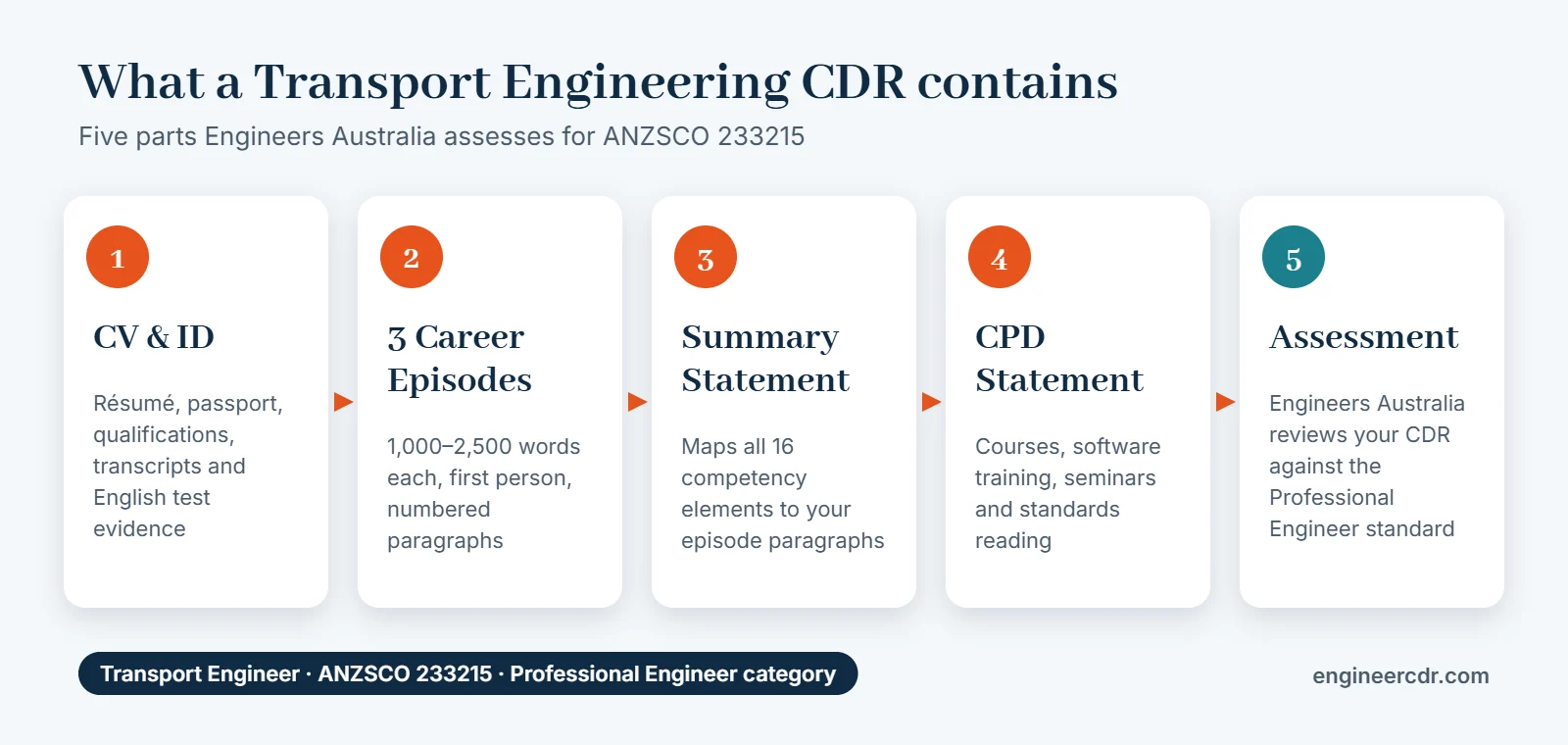
A CDR has three technical parts: three career episodes that describe your engineering work, a summary statement that maps your episodes to each competency element, and a CPD statement that lists your continuing professional development.
What does a Transport Engineer do?
Transport engineers plan, design and manage the infrastructure and systems that move people and goods. Typical work you can draw on for your episodes includes:
- Traffic studies, traffic impact assessments and demand forecasting
- Geometric design of roads, intersections and roundabouts
- Signal timing, coordination and intersection performance analysis
- Public transport, bus priority and network planning
- Road safety audits, crash analysis and treatment design
- Pedestrian, cycling and active transport facilities
- Parking, access and site layout design
- Transport modelling and microsimulation
What a Transport Engineering CDR contains
| Component | What Engineers Australia expects | Tip for transport engineers |
|---|---|---|
| Career Episode 1 | An engineering activity or project, 1,000 to 2,500 words, in first person | Pick your strongest design or analysis project |
| Career Episode 2 | A different activity that shows other competencies | Show a different skill, for example a safety audit or modelling study |
| Career Episode 3 | A third activity, which can be study-based for recent graduates | Cover project management or multidisciplinary work |
| Summary statement | Maps every competency element to numbered paragraphs in your episodes | Cross-reference paragraph numbers exactly |
| CPD statement | Written evidence of continuing professional development | Include courses, software training, seminars and standards reading |
| CV and supporting documents | Résumé, qualifications, transcripts, ID, English test evidence | Keep project titles and dates consistent with your episodes |
Career episode ideas for Transport Engineers
Choose projects where you made the engineering decisions. Strong options include:
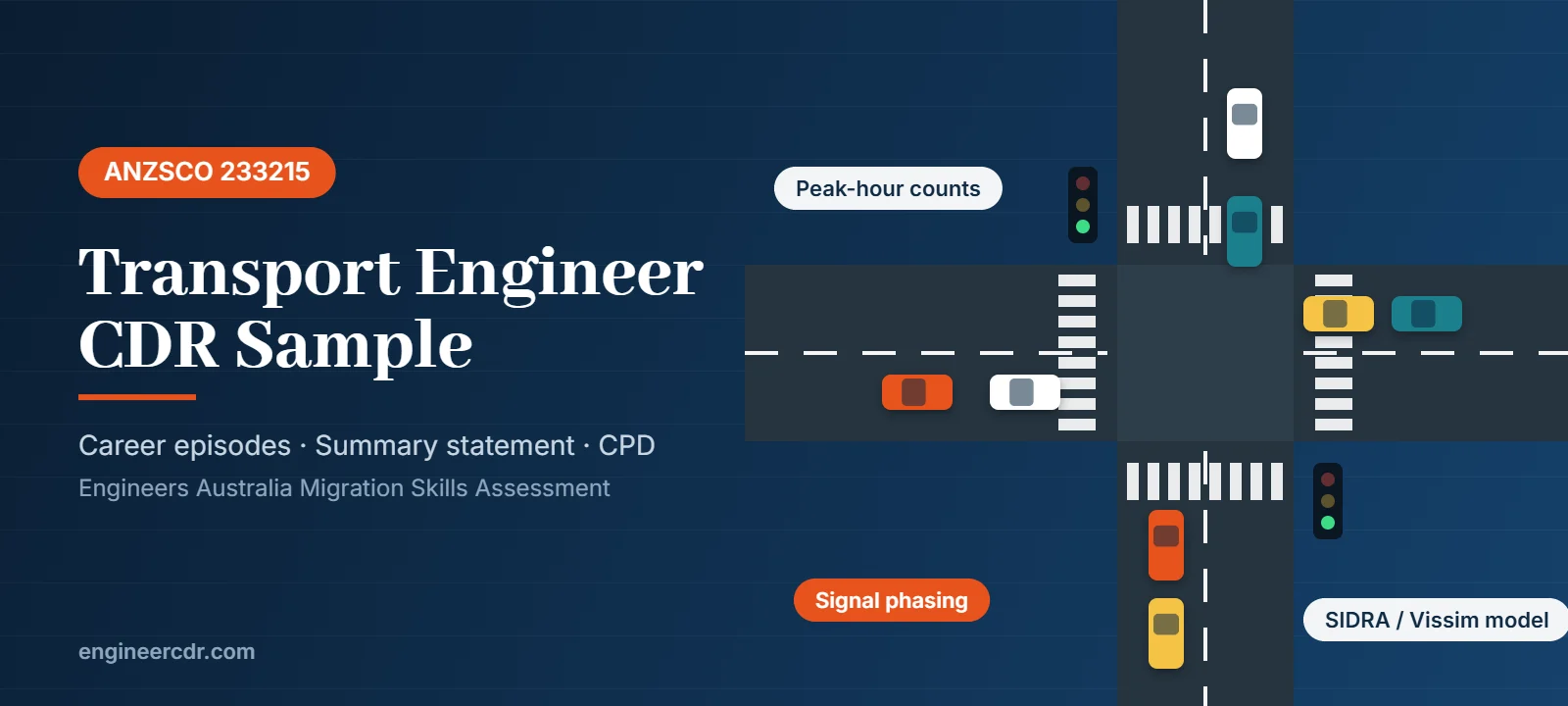
- Signalised intersection upgrade: traffic counts, phasing design, SIDRA or Vissim modelling, before and after performance.
- Traffic impact assessment: trip generation, distribution, network capacity checks and mitigation measures for a development.
- Road geometric design: alignment, sight distance, cross sections and drainage coordination using the design standard of your country.
- Road safety audit: crash data analysis, hazard identification and treatment recommendations.
- Bus rapid transit or public transport corridor: route planning, stop spacing, priority measures and demand analysis.
- Pedestrian and cycling facilities: network gaps, crossing design and accessibility compliance.
- Parking or site access design: layout, swept paths, circulation and compliance checks.
- Final-year project or thesis: suitable for recent graduates, as long as you describe your personal contribution.
How to structure each career episode
Engineers Australia asks you to follow the engineering method of defining, planning and designing, delivering and evaluating. A clear four-part layout works well:
| Section | Approximate length | What to cover |
|---|---|---|
| Introduction | 50 to 100 words | Project title, dates, location, organisation, your position |
| Background | 200 to 500 words | Project purpose, scope, site, stakeholders, standards, your team and your role |
| Personal engineering activity | 600 to 1,800 words | What you did: methods, calculations, software, decisions, problems solved and results |
| Summary | 50 to 150 words | Outcome, what you delivered and what you learned |
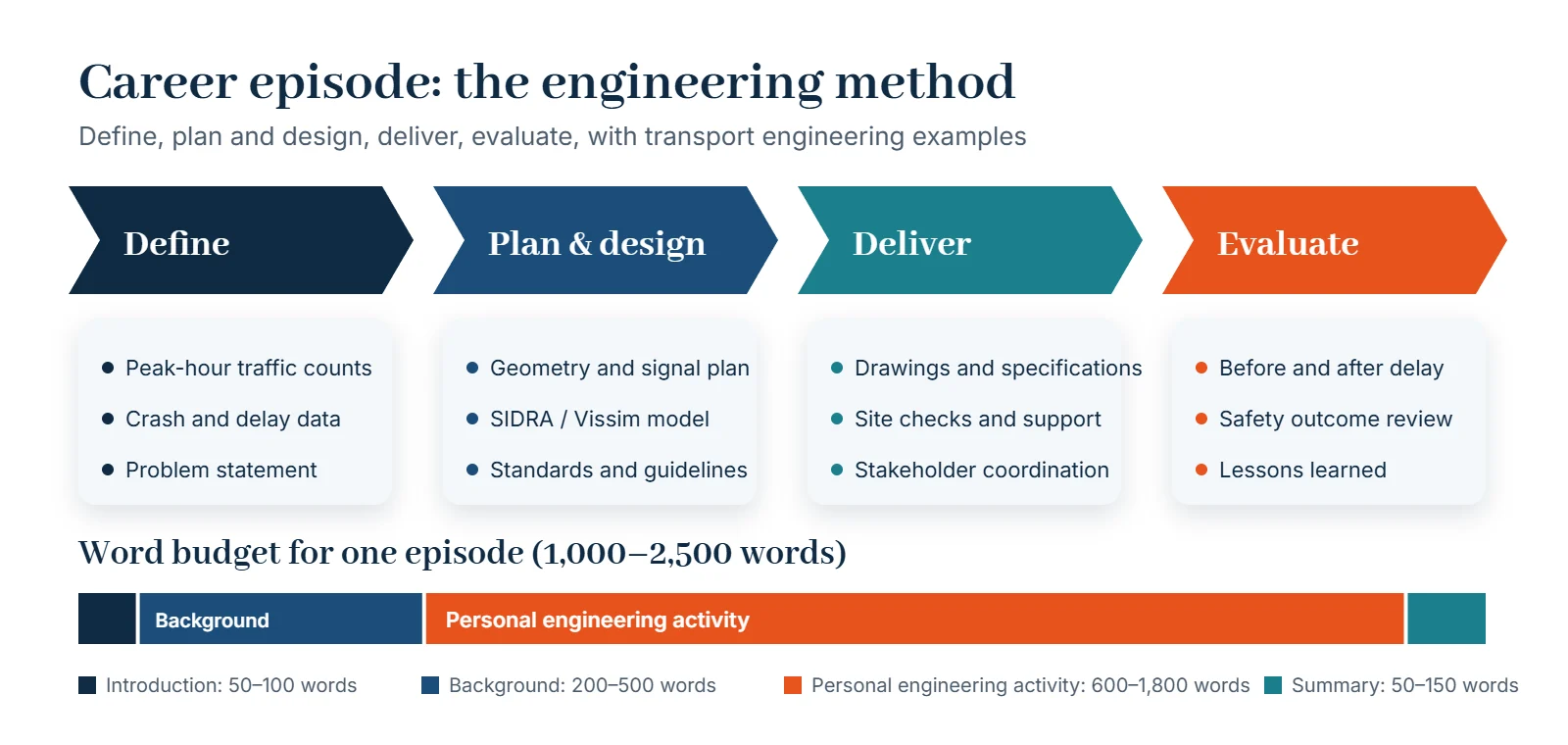
Write in the first person (“I analysed”, not “we analysed”), number every paragraph, and spend most of the word count on the personal engineering activity.
Illustrative excerpt (fictional, for structure only)
This short example is invented to show tone and level of detail. Do not copy it; your episodes must describe your own work.
CE 2.4 I collected turning movement counts for the morning and evening peaks and converted them to passenger car units. I then built a SIDRA Intersection model of the existing layout and calibrated the queue lengths against field observations. The model showed the right-turn movement operating at a degree of saturation above 1.0.
CE 2.5 I proposed an additional right-turn lane and a revised four-phase signal plan. I checked the lane widths and storage length against the relevant design guidelines and recalculated cycle time and delay. The revised layout reduced average delay in the model and brought every approach below the target degree of saturation.
How the summary statement maps competencies
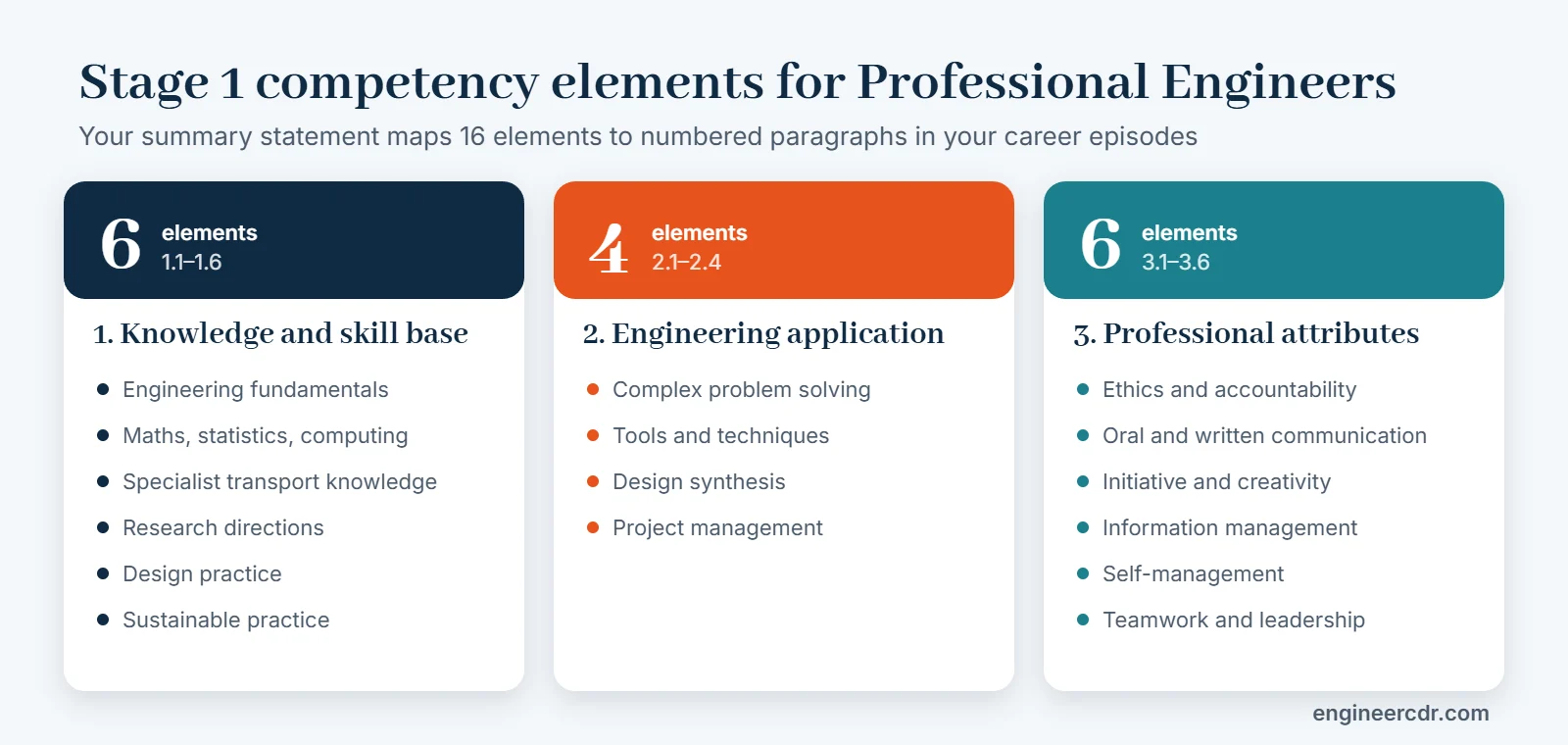
The summary statement is a table. For each of the 16 elements of the Stage 1 Competency Standard, you quote the paragraph numbers from your episodes where you demonstrated it. The elements fall into three areas:
| Area | Elements | Transport engineering evidence |
|---|---|---|
| 1. Knowledge and skill base | 1.1 to 1.6 | Traffic engineering theory, statistics, specialist transport knowledge, design practice, sustainability |
| 2. Engineering application ability | 2.1 to 2.4 | Problem solving, software and tools, design synthesis, project management |
| 3. Professional and personal attributes | 3.1 to 3.6 | Ethics, communication, initiative, information management, self-management, teamwork |
Use the official Engineers Australia summary statement template for the Professional Engineer category and make sure every element is covered at least once across your three episodes.
CPD examples for Transport Engineers
| Activity type | Examples |
|---|---|
| Formal courses | Traffic engineering, road safety audit, transport modelling or project management courses |
| Software training | SIDRA Intersection, PTV Vissim, Aimsun, AutoCAD Civil 3D, 12d Model |
| Seminars and conferences | Transport and road safety conferences, professional society events, webinars |
| Standards and self-study | Reading design guidelines, codes and technical papers relevant to your work |
| On-the-job learning | Mentoring, design reviews and site training, documented with dates and outcomes |
Common reasons a Transport Engineering CDR is rejected
- Copied or ghost-written content that fails Engineers Australia’s plagiarism checks
- Using “we” so your personal contribution is unclear
- Describing the project but not your own engineering decisions and calculations
- Missing competency elements or wrong paragraph references in the summary statement
- Episodes shorter than 1,000 words or far above 2,500 words
- Dates, employers or project titles that do not match your CV
- Generic text with no standards, tools, data or results
How to write your Transport Engineering CDR, step by step
- Download the current Engineers Australia migration skills assessment booklet and competency templates.
- List every project you have worked on and choose three with clear personal engineering work.
- Note the data, standards, software, calculations and results for each project.
- Draft each episode in four sections, in the first person, with numbered paragraphs.
- Complete the summary statement by mapping each competency element to paragraph numbers.
- Prepare the CPD statement and a CV that matches your episodes.
- Review for originality, consistency and grammar before you submit.
Frequently asked questions
How many career episodes do I need for a Transport Engineer CDR?
You need three career episodes. Each should be between 1,000 and 2,500 words, written in English in the first person.
Can I copy a CDR sample for transport engineering?
No. Engineers Australia treats copied work, or work written by another person, as plagiarism. The consequences include rejection and a reapplication ban of 12, 24 or 36 months. Use samples only to understand structure.
Which authority assesses ANZSCO 233215 Transport Engineer?
Engineers Australia assesses the Transport Engineer occupation for migration skills assessment purposes.
What is the summary statement in a CDR?
The summary statement is a table that lists each competency element in the Stage 1 Competency Standard and shows which numbered paragraphs in your career episodes demonstrate it.
Can recent graduates use university projects as career episodes?
Yes. Engineers Australia allows study-based projects for recent graduates. For group projects, describe only your personal contribution.
What should a Transport Engineer include in CPD?
Include courses, software training, seminars, conferences, standards reading and on-the-job learning, with dates and descriptions of what you learned.
Is Transport Engineer on the skilled occupation list?
Transport Engineer (233215) has been listed on Australia’s Core Skills Occupation List, but lists change. Check the Department of Home Affairs website and your visa subclass before you apply.
How long should a career episode be?
Between 1,000 and 2,500 words. Most of the text should explain the engineering work you personally did.
Get your Transport Engineering CDR reviewed
Engineer CDR provides CDR review, editing and plagiarism checking and summary statement guidance, so your own draft is clear, consistent and competency-mapped. For service details, see our CDR for Transport Engineers (ANZSCO 233215) page, or email info@engineercdr.com.
Want a second pair of eyes on your CDR?
Send us your own draft for review, editing and a plagiarism check against Engineers Australia’s requirements.
Related CDR samples and guides
- CDR sample for Civil Engineering (233211)
- CDR sample for Structural Engineering (233214)
- CDR sample for Geotechnical Engineering (233212)
- CDR report samples and structure guide
Source: Engineers Australia, Prepare your Migration Skills Assessment application. Requirements can change, so always check the current booklet.
