A CDR sample for an environmental engineer shows how to structure the three career episodes, summary statement and CPD list that Engineers Australia assesses for ANZSCO 233915 (Environmental Engineer). This guide breaks down each part of a Environmental Engineering CDR, with career episode ideas, competency mapping, an illustrative excerpt and answers to the questions applicants ask most. Last updated: October 2026.
Write it yourself. Engineers Australia requires career episodes and the summary statement to be your own work. Copying a sample, or having another person or company write them, counts as plagiarism and can lead to rejection and a 12, 24 or 36 month reapplication ban. Use this page to understand the structure, then write from your own projects.
Environmental Engineer (ANZSCO 233915) at a glance
| Item | Detail |
|---|---|
| Occupation | Environmental Engineer |
| ANZSCO code | 233915 |
| Assessing authority | Engineers Australia (Migration Skills Assessment) |
| Competency standard | Stage 1 Competency Standard for Professional Engineer (16 elements of competency) |
| Core documents | CV, three career episodes, summary statement, CPD statement, ID, qualifications and English language evidence |
| Career episode length | 1,000 to 2,500 words each, first person, numbered paragraphs |
| Typical qualification | Bachelor degree in environmental, civil or chemical engineering, or a closely related field |
| Related occupations | Civil Engineer (233211), Chemical Engineer (233111) |
What is a CDR for an Environmental Engineer?
A Competency Demonstration Report (CDR) is the evidence pathway Engineers Australia uses to assess whether your qualifications and experience match the occupation you nominate. For an Environmental Engineer, the assessor looks for proof that you assessed, designed or managed engineering solutions that protect the environment and public health at professional engineer level, such as water and wastewater treatment, contaminated land remediation, waste management, air quality control and environmental impact assessment.
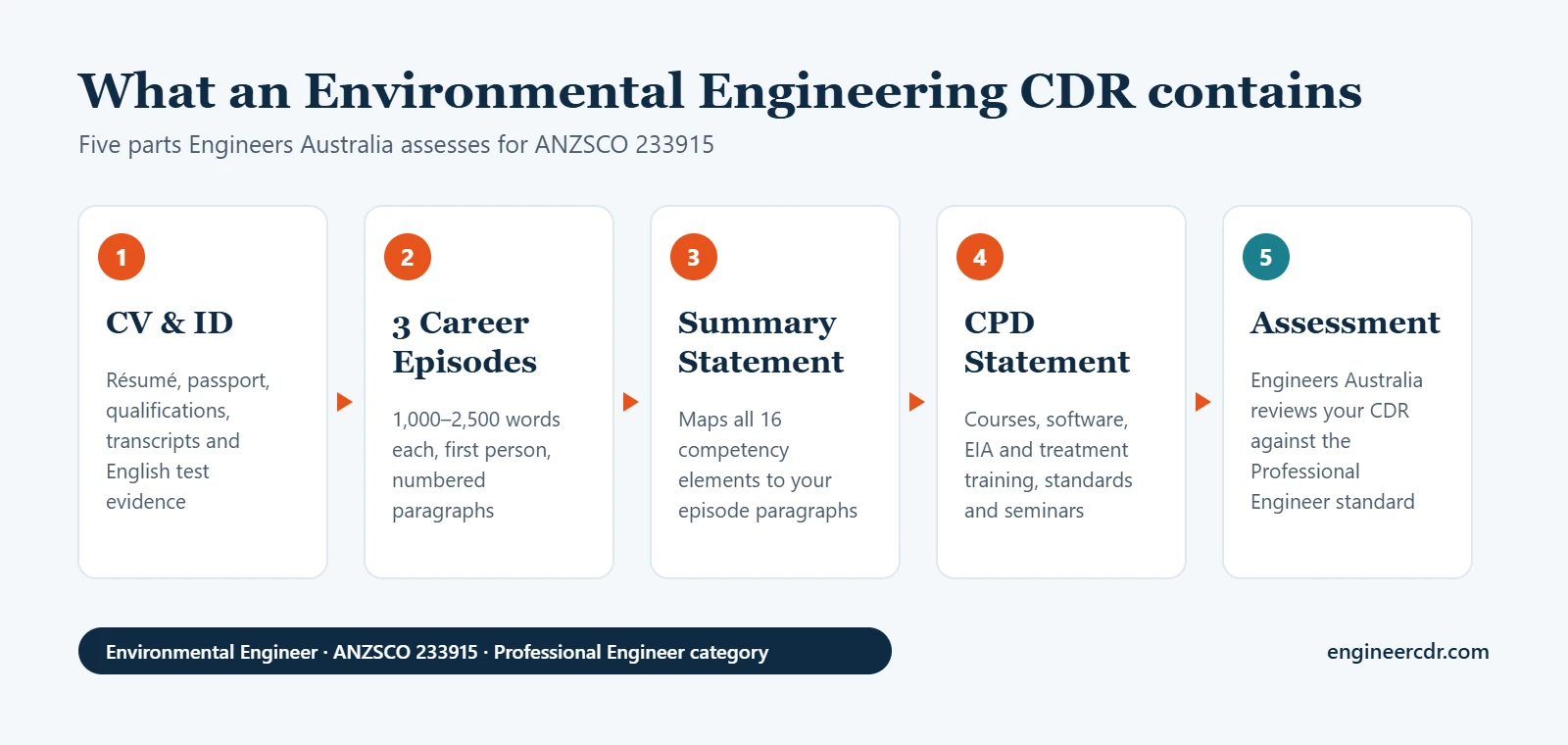
A CDR has three technical parts: three career episodes that describe your engineering work, a summary statement that maps your episodes to each competency element, and a CPD statement that lists your continuing professional development.
What does an Environmental Engineer do?
Environmental engineers apply engineering principles to prevent, control and remediate pollution and to manage natural resources sustainably. Typical work you can draw on for your episodes includes:
- Water and wastewater treatment process design and upgrades
- Stormwater management, drainage and water sensitive urban design
- Contaminated site investigation and remediation design
- Solid and hazardous waste management, landfill and recycling systems
- Air quality assessment, emission control and dispersion modelling
- Environmental impact assessments and environmental management plans
- Environmental monitoring programmes and compliance reporting
- Sustainability, energy efficiency and carbon reduction projects
Environmental vs Civil vs Chemical Engineer CDR
Environmental engineering overlaps with civil and chemical engineering, so it is important to nominate the occupation that matches most of your duties. Engineers Australia assesses you against the occupation whose duties best match your qualifications and experience.
| Occupation | ANZSCO | Main focus of your episodes |
|---|---|---|
| Environmental Engineer | 233915 | Pollution control, treatment, remediation, waste, air quality and environmental assessment |
| Civil Engineer | 233211 | Roads, drainage, water networks, earthworks and civil infrastructure design |
| Chemical Engineer | 233111 | Chemical and process plant design, reactions, separation and process safety |
If most of your engineering work is about treatment processes, environmental compliance and remediation, ANZSCO 233915 is usually the closest fit. See also our Civil Engineering CDR sample and Chemical Engineering CDR sample.
What an Environmental Engineering CDR contains
| Component | What Engineers Australia expects | Tip for environmental engineers |
|---|---|---|
| Career Episode 1 | An engineering activity or project, 1,000 to 2,500 words, in first person | Pick your strongest treatment design or remediation project |
| Career Episode 2 | A different activity that shows other competencies | Show a different skill, for example modelling or an impact assessment |
| Career Episode 3 | A third activity, which can be study-based for recent graduates | Cover project management, monitoring or regulatory approvals |
| Summary statement | Maps every competency element to numbered paragraphs in your episodes | Cross-reference paragraph numbers exactly |
| CPD statement | Written evidence of continuing professional development | Include treatment, modelling and environmental standards training |
| CV and supporting documents | Résumé, qualifications, transcripts, ID, English test evidence | Keep project names, clients and dates consistent with your episodes |
Career episode ideas for Environmental Engineers
Choose projects where you made the engineering decisions. Strong options include:
- Wastewater treatment plant upgrade: influent characterisation, process selection, sizing and effluent compliance.
- Water treatment design: raw water quality, coagulation, filtration and disinfection design checks.
- Contaminated land remediation: site investigation, risk assessment and remediation option design.
- Stormwater and water sensitive urban design: catchment analysis, treatment devices and runoff modelling.
- Air emission control: emission inventory, dispersion modelling and selection of control equipment.
- Environmental impact assessment: baseline studies, impact prediction and mitigation measures.
- Solid waste or landfill design: waste characterisation, cell design, leachate and gas management.
- Energy or carbon reduction project: baseline, options analysis and measured savings.
- Final-year project or thesis: suitable for recent graduates, as long as you describe your personal contribution.
How to structure each career episode
Engineers Australia asks you to follow the engineering method of defining, planning and designing, delivering and evaluating. A clear four-part layout works well:
| Section | Approximate length | What to cover |
|---|---|---|
| Introduction | 50 to 100 words | Project title, dates, location, organisation, your position |
| Background | 200 to 500 words | Site, pollutant or resource issue, project purpose, regulations and permits, stakeholders, your team and your role |
| Personal engineering activity | 600 to 1,800 words | What you did: sampling, analysis, calculations, modelling, design decisions, problems solved and results |
| Summary | 50 to 150 words | Outcome, what you delivered and what you learned |
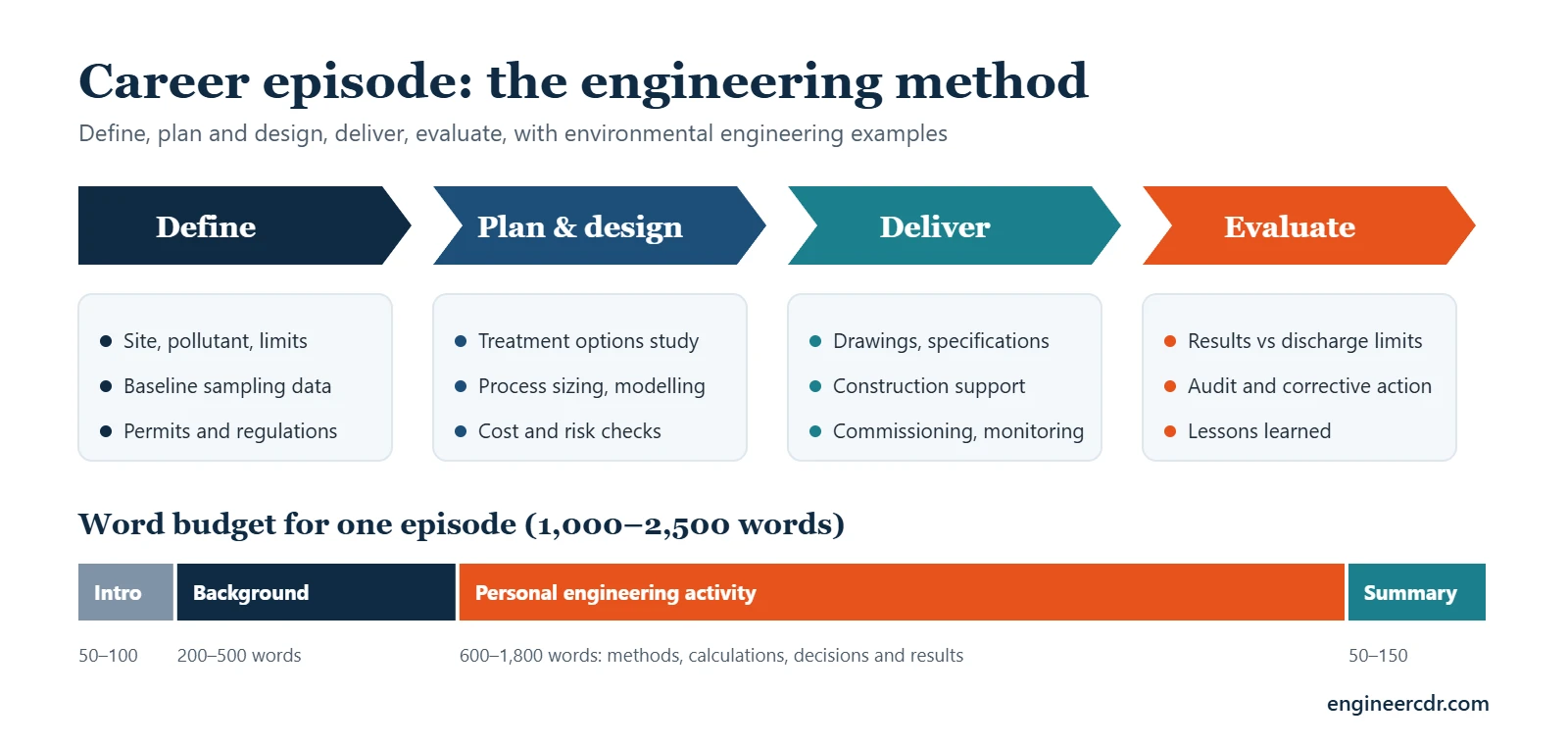
Write in the first person (“I analysed”, not “we analysed”), number every paragraph, and spend most of the word count on the personal engineering activity.
Illustrative excerpt (fictional, for structure only)
This short example is invented to show tone and level of detail. Do not copy it; your episodes must describe your own work.
CE 3.5 I reviewed twelve months of influent and effluent data for the municipal treatment plant and found that ammonia in the treated effluent exceeded the new licence limit during the winter months. I calculated the existing aeration capacity and sludge age and confirmed that nitrification was limited at low temperatures.
CE 3.6 I compared two upgrade options, an extended aeration volume and a moving bed biofilm reactor retrofit. I sized both options using the design loads, estimated capital and operating costs, and recommended the retrofit because it fitted within the existing tanks. After commissioning, I set up a monitoring schedule and the effluent ammonia remained within the licence limit through the following winter.
How the summary statement maps competencies
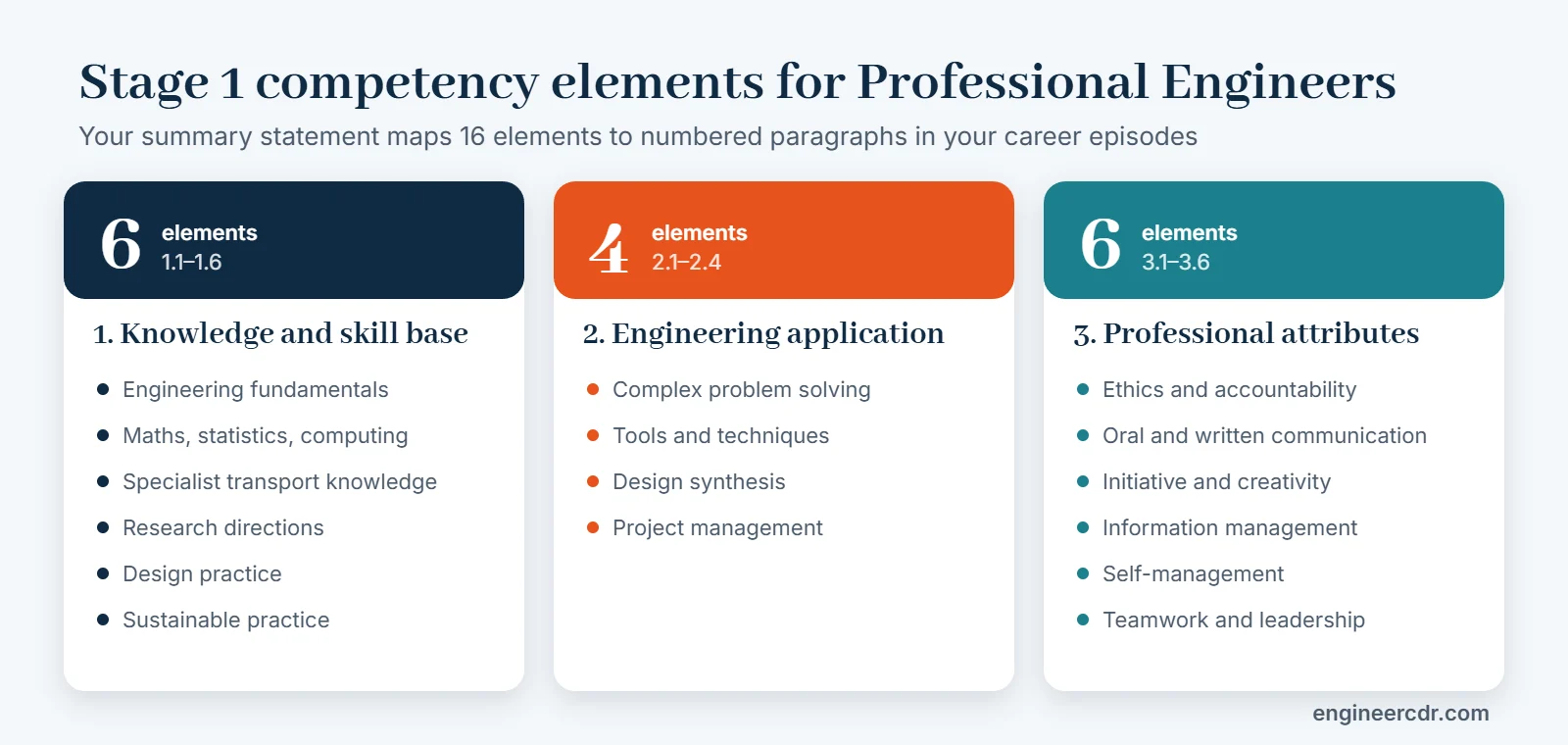
The summary statement is a table. For each of the 16 elements of the Stage 1 Competency Standard, you quote the paragraph numbers from your episodes where you demonstrated it. The elements fall into three areas:
| Area | Elements | Environmental engineering evidence |
|---|---|---|
| 1. Knowledge and skill base | 1.1 to 1.6 | Treatment process theory, chemistry and microbiology, hydrology, environmental legislation, sustainability |
| 2. Engineering application ability | 2.1 to 2.4 | Problem solving, modelling software, treatment and remediation design, project management |
| 3. Professional and personal attributes | 3.1 to 3.6 | Ethics and public health responsibility, communication with regulators and communities, initiative, records, self-management, teamwork |
Use the official Engineers Australia summary statement template for the Professional Engineer category and make sure every element is covered at least once across your three episodes. Our summary statement guidance explains the mapping in more detail.
CPD examples for Environmental Engineers
| Activity type | Examples |
|---|---|
| Formal courses | Wastewater treatment, contaminated land, air quality or environmental management courses |
| Software training | GIS, MUSIC, EPA SWMM, AERMOD, BioWin or AutoCAD Civil 3D |
| Seminars and conferences | Water industry, waste and environmental engineering conferences, professional society events, webinars |
| Standards and self-study | Environmental guidelines, discharge licence conditions, ISO 14001 and technical papers |
| On-the-job learning | Site inspections, sampling campaigns, audits and design reviews, documented with dates and outcomes |
Common reasons an Environmental Engineering CDR is rejected
- Copied or ghost-written content that fails Engineers Australia’s plagiarism checks
- Using “we” so your personal contribution is unclear
- Episodes that describe sampling or reporting only, without your own engineering analysis or design
- Quoting regulations without showing how your design met them
- Missing competency elements or wrong paragraph references in the summary statement
- Episodes shorter than 1,000 words or far above 2,500 words
- Dates, employers or project names that do not match your CV
How to write your Environmental Engineering CDR, step by step
- Download the current Engineers Australia migration skills assessment booklet and competency templates.
- Confirm that ANZSCO 233915 matches most of your duties, compared with Civil or Chemical Engineer.
- List your projects and choose three with clear personal engineering work.
- Collect the data, calculations, models, permits, drawings and monitoring results for each project.
- Draft each episode in four sections, in the first person, with numbered paragraphs.
- Complete the summary statement by mapping each competency element to paragraph numbers.
- Prepare the CPD statement and a CV that matches your episodes, then review for originality and consistency.
Frequently asked questions
How many career episodes do I need for an Environmental Engineer CDR?
You need three career episodes. Each should be between 1,000 and 2,500 words, written in English in the first person, with numbered paragraphs.
Can I copy a CDR sample for environmental engineering?
No. Engineers Australia treats copied work, or work written by another person, as plagiarism. The consequences include rejection and a reapplication ban of 12, 24 or 36 months. Use samples only to understand structure.
Which authority assesses ANZSCO 233915 Environmental Engineer?
Engineers Australia assesses the Environmental Engineer occupation for migration skills assessment purposes, against the Stage 1 Competency Standard for Professional Engineers.
What projects work best for an Environmental Engineer CDR?
Projects where you did the engineering analysis and design yourself, such as treatment plant upgrades, remediation design, stormwater systems, emission control or impact assessments with technical modelling.
Can environmental monitoring work be used as a career episode?
Yes, if you show engineering work such as interpreting data, identifying problems, designing improvements and checking results. Routine sampling and reporting alone will not demonstrate professional engineer competencies.
What should an Environmental Engineer include in CPD?
Include courses, software training, environmental guidelines and standards reading, conferences and on-the-job learning, with dates and what you learned.
Is Environmental Engineer on the skilled occupation list?
Environmental Engineer (233915) has been listed on Australia’s skilled occupation lists, but lists change. Check the Department of Home Affairs website and your visa subclass before you apply.
How long should a career episode be?
Between 1,000 and 2,500 words. Most of the text should explain the engineering work you personally did, including methods, calculations, decisions and results.
Get your Environmental Engineering CDR reviewed
Engineer CDR provides CDR review, editing and plagiarism checking and summary statement guidance, so your own draft is clear, consistent and competency-mapped. For service details, see our CDR for Environmental Engineers (ANZSCO 233915) page, or email info@engineercdr.com.
Want a second pair of eyes on your CDR?
Send us your own draft for review, editing and a plagiarism check against Engineers Australia’s requirements.
Related CDR samples and guides
- CDR sample for Civil Engineering (233211)
- CDR sample for Chemical Engineering (233111)
- CDR sample for Transport Engineer (233215)
- CDR report samples and structure guide
Source: Engineers Australia, Prepare your Migration Skills Assessment application. Requirements can change, so always check the current booklet.
