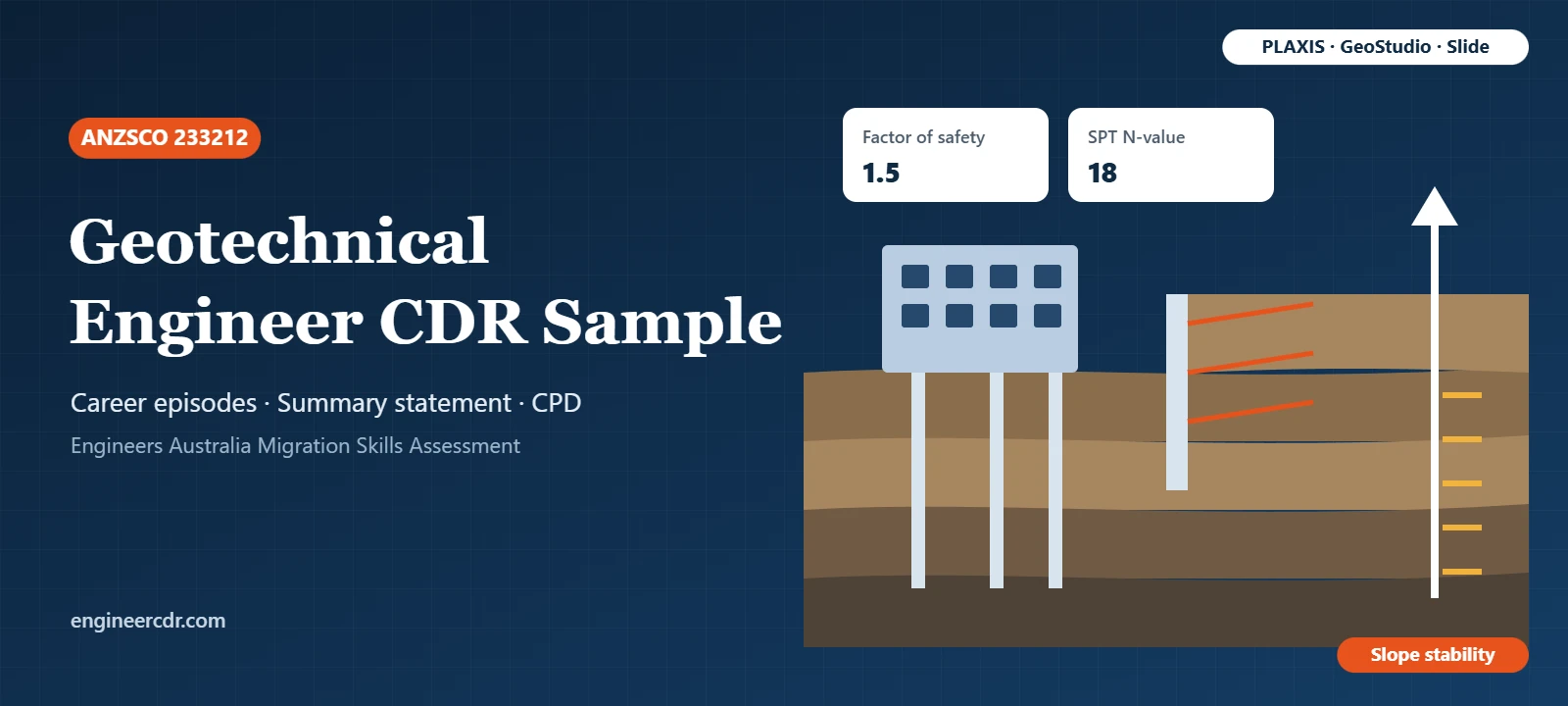
A CDR sample for a geotechnical engineer shows how to structure the three career episodes, summary statement and CPD list that Engineers Australia assesses for ANZSCO 233212 (Geotechnical Engineer). This guide breaks down each part of a Geotechnical Engineering CDR, with career episode ideas, competency mapping, an illustrative excerpt and answers to the questions applicants ask most. Last updated: October 2026.
Write it yourself. Engineers Australia requires career episodes and the summary statement to be your own work. Copying a sample, or having another person or company write them, counts as plagiarism and can lead to rejection and a 12, 24 or 36 month reapplication ban. Use this page to understand the structure, then write from your own projects.
Geotechnical Engineer (ANZSCO 233212) at a glance
| Item | Detail |
|---|---|
| Occupation | Geotechnical Engineer |
| ANZSCO code | 233212 |
| Assessing authority | Engineers Australia (Migration Skills Assessment) |
| Competency standard | Stage 1 Competency Standard for Professional Engineer (16 elements of competency) |
| Core documents | CV, three career episodes, summary statement, CPD statement, ID, qualifications and English language evidence |
| Career episode length | 1,000 to 2,500 words each, first person, numbered paragraphs |
| Typical qualification | Bachelor degree in civil or geotechnical engineering, or a closely related field |
| Related occupations | Civil Engineer (233211), Structural Engineer (233214) |
What is a CDR for a Geotechnical Engineer?
A Competency Demonstration Report (CDR) is the evidence pathway Engineers Australia uses to assess whether your qualifications and experience match the occupation you nominate. For a Geotechnical Engineer, the assessor looks for proof that you investigated ground conditions and designed or assessed foundations, earthworks, slopes, retaining structures or tunnels at professional engineer level, using soil and rock parameters, analysis and design standards.
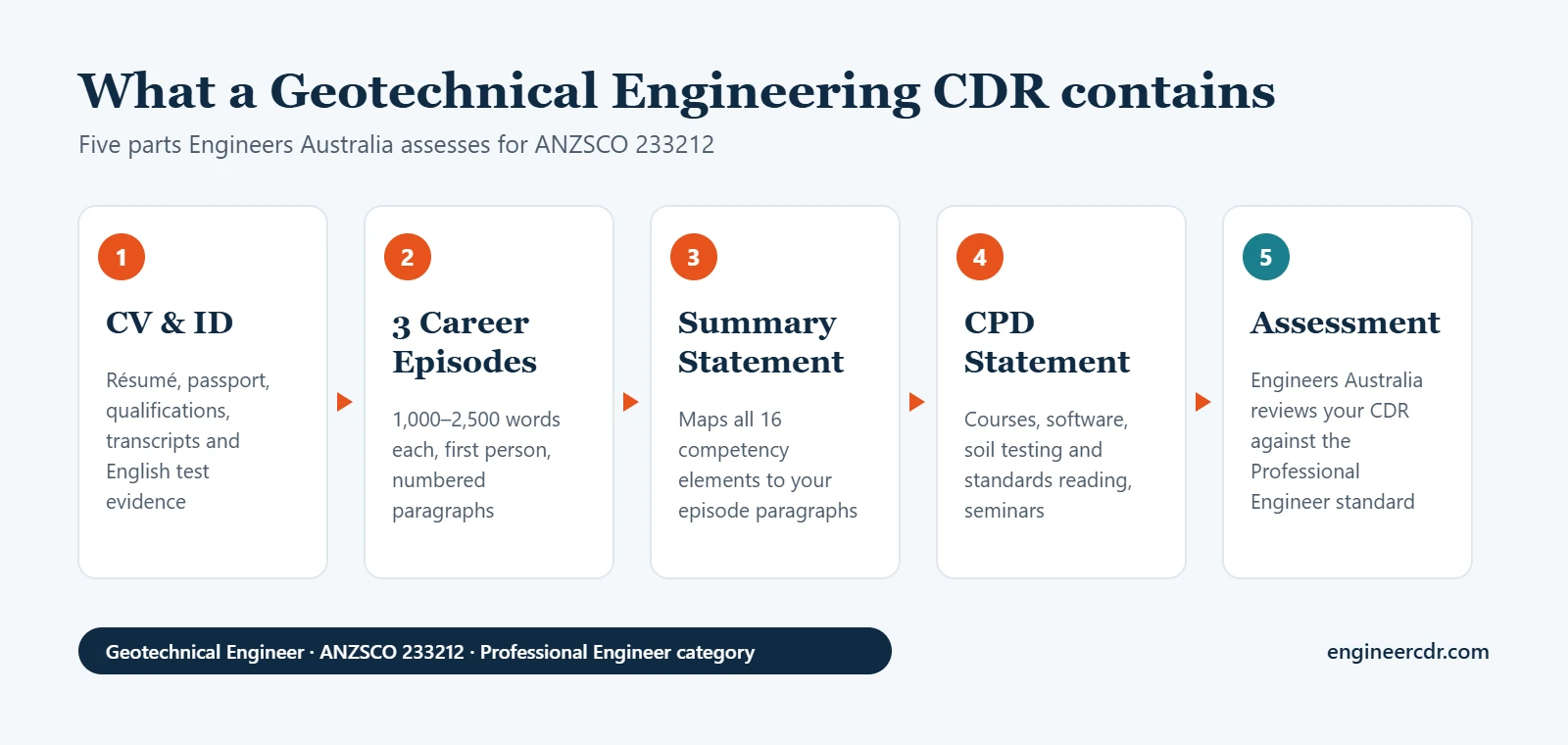
A CDR has three technical parts: three career episodes that describe your engineering work, a summary statement that maps your episodes to each competency element, and a CPD statement that lists your continuing professional development.
What does a Geotechnical Engineer do?
Geotechnical engineers study how soil and rock behave and design the ground-related parts of projects so they are safe and economical. Typical work you can draw on for your episodes includes:
- Planning and supervising site investigations, boreholes and in-situ testing
- Interpreting laboratory results and selecting design soil and rock parameters
- Shallow and deep foundation design, including piles
- Slope stability analysis and slope stabilisation design
- Retaining walls, anchors, soil nails and excavation support
- Ground improvement, earthworks and pavement subgrade design
- Settlement, consolidation and groundwater assessments
- Construction monitoring with instruments and observational methods
Geotechnical vs Civil vs Structural Engineer CDR
Geotechnical engineering sits within the wider civil field, so many applicants are unsure which code to nominate. Engineers Australia assesses you against the occupation whose duties best match your qualifications and experience.
| Occupation | ANZSCO | Main focus of your episodes |
|---|---|---|
| Geotechnical Engineer | 233212 | Ground investigation, soil and rock mechanics, foundations, slopes, retaining structures |
| Civil Engineer | 233211 | Roads, drainage, water networks, earthworks and general civil infrastructure |
| Structural Engineer | 233214 | Design of buildings, bridges and structural members above the foundation |
If most of your engineering decisions relate to ground behaviour and geotechnical design, ANZSCO 233212 is usually the closest fit. See also our Civil Engineering CDR sample and Structural Engineering CDR sample.
What a Geotechnical Engineering CDR contains
| Component | What Engineers Australia expects | Tip for geotechnical engineers |
|---|---|---|
| Career Episode 1 | An engineering activity or project, 1,000 to 2,500 words, in first person | Pick your strongest foundation, slope or retaining design project |
| Career Episode 2 | A different activity that shows other competencies | Show a different skill, for example a site investigation or ground improvement |
| Career Episode 3 | A third activity, which can be study-based for recent graduates | Cover construction monitoring, project management or risk |
| Summary statement | Maps every competency element to numbered paragraphs in your episodes | Cross-reference paragraph numbers exactly |
| CPD statement | Written evidence of continuing professional development | Include software, testing and design standard training |
| CV and supporting documents | Résumé, qualifications, transcripts, ID, English test evidence | Keep project names, sites and dates consistent with your episodes |
Career episode ideas for Geotechnical Engineers
Choose projects where you made the engineering decisions. Strong options include:
- Pile foundation design: borehole data, pile capacity calculations, load tests and settlement checks.
- Shallow foundation design: bearing capacity, settlement analysis and ground improvement options.
- Slope stability and remediation: back-analysis of a failure, factor of safety checks and stabilisation measures.
- Retaining wall or deep excavation: earth pressures, anchors or soil nails, groundwater and staged construction.
- Site investigation programme: borehole layout, in-situ tests, lab testing and the geotechnical report.
- Ground improvement: preloading, wick drains, stone columns or soil stabilisation with monitoring.
- Road or embankment earthworks: subgrade assessment, compaction specification and embankment stability.
- Tunnel or underground works: rock mass classification, support design and convergence monitoring.
- Final-year project or thesis: suitable for recent graduates, as long as you describe your personal contribution.
How to structure each career episode
Engineers Australia asks you to follow the engineering method of defining, planning and designing, delivering and evaluating. A clear four-part layout works well:
| Section | Approximate length | What to cover |
|---|---|---|
| Introduction | 50 to 100 words | Project title, dates, location, organisation, your position |
| Background | 200 to 500 words | Site, geology, project purpose, scope, design codes, stakeholders, your team and your role |
| Personal engineering activity | 600 to 1,800 words | What you did: investigation, testing, parameter selection, calculations, software modelling, design decisions and results |
| Summary | 50 to 150 words | Outcome, what you delivered and what you learned |
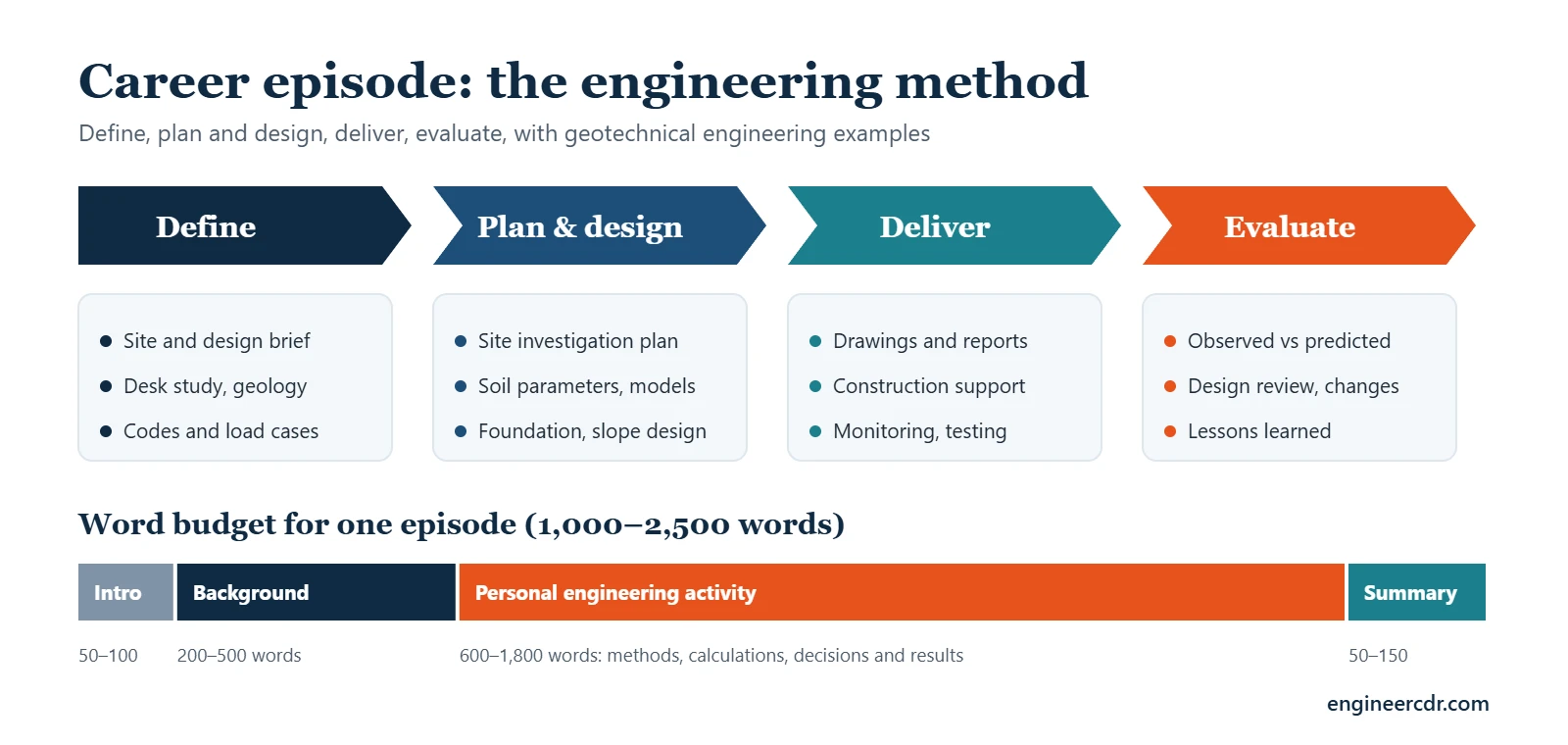
Write in the first person (“I analysed”, not “we analysed”), number every paragraph, and spend most of the word count on the personal engineering activity.
Illustrative excerpt (fictional, for structure only)
This short example is invented to show tone and level of detail. Do not copy it; your episodes must describe your own work.
CE 2.4 I reviewed the logs of six boreholes and the laboratory results for the proposed warehouse site and identified a soft clay layer between 3 and 7 metres depth. Using the consolidation test results, I estimated the settlement under the design floor load and found it exceeded the client’s tolerance.
CE 2.5 I compared a piled slab with preloading using wick drains. I calculated the time required for consolidation with drains at two spacings and checked the stability of the preload embankment using limit equilibrium software. I recommended preloading with wick drains at the closer spacing because it met the programme at lower cost, and I prepared the settlement monitoring plan for construction.
How the summary statement maps competencies
The summary statement is a table. For each of the 16 elements of the Stage 1 Competency Standard, you quote the paragraph numbers from your episodes where you demonstrated it. The elements fall into three areas:
| Area | Elements | Geotechnical engineering evidence |
|---|---|---|
| 1. Knowledge and skill base | 1.1 to 1.6 | Soil and rock mechanics, engineering geology, statistics for parameter selection, design practice, sustainability |
| 2. Engineering application ability | 2.1 to 2.4 | Problem solving, PLAXIS, GeoStudio or Slide modelling, foundation and slope design, project management |
| 3. Professional and personal attributes | 3.1 to 3.6 | Ethics and public safety, communication with clients and contractors, initiative, records, self-management, teamwork |
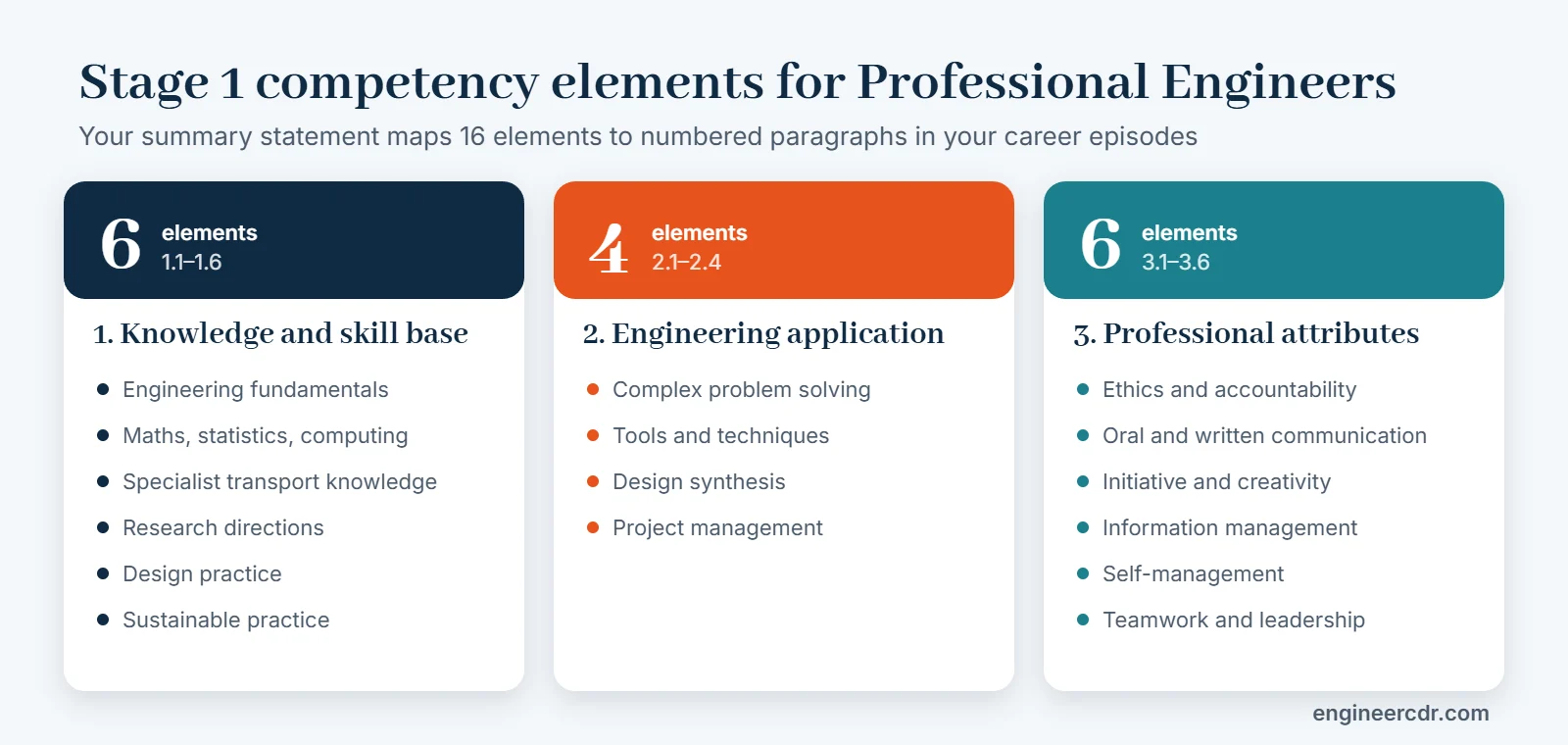
Use the official Engineers Australia summary statement template for the Professional Engineer category and make sure every element is covered at least once across your three episodes. Our summary statement guidance explains the mapping in more detail.
CPD examples for Geotechnical Engineers
| Activity type | Examples |
|---|---|
| Formal courses | Foundation design, slope stability, ground improvement or rock engineering courses |
| Software training | PLAXIS, GeoStudio, Slide, gINT, LPile or AutoCAD Civil 3D |
| Seminars and conferences | Geotechnical society events, conferences and webinars |
| Standards and self-study | Site investigation, piling and earth-retaining structure standards, for example AS 1726, AS 2159 and AS 4678, and technical papers |
| On-the-job learning | Site visits, pile load tests, instrumentation reviews and design reviews, documented with dates and outcomes |
Common reasons a Geotechnical Engineering CDR is rejected
- Copied or ghost-written content that fails Engineers Australia’s plagiarism checks
- Using “we” so your personal contribution is unclear
- Episodes that describe logging or testing only, without your own analysis and design decisions
- Quoting factors of safety without explaining the parameters and methods behind them
- Missing competency elements or wrong paragraph references in the summary statement
- Episodes shorter than 1,000 words or far above 2,500 words
- Dates, employers or project names that do not match your CV
How to write your Geotechnical Engineering CDR, step by step
- Download the current Engineers Australia migration skills assessment booklet and competency templates.
- Confirm that ANZSCO 233212 matches most of your duties, compared with Civil or Structural Engineer.
- List your projects and choose three with clear personal engineering work.
- Collect the borehole logs, test results, calculations, models, drawings and monitoring data for each project.
- Draft each episode in four sections, in the first person, with numbered paragraphs.
- Complete the summary statement by mapping each competency element to paragraph numbers.
- Prepare the CPD statement and a CV that matches your episodes, then review for originality and consistency.
Frequently asked questions
How many career episodes do I need for a Geotechnical Engineer CDR?
You need three career episodes. Each should be between 1,000 and 2,500 words, written in English in the first person, with numbered paragraphs.
Can I copy a CDR sample for geotechnical engineering?
No. Engineers Australia treats copied work, or work written by another person, as plagiarism. The consequences include rejection and a reapplication ban of 12, 24 or 36 months. Use samples only to understand structure.
Which authority assesses ANZSCO 233212 Geotechnical Engineer?
Engineers Australia assesses the Geotechnical Engineer occupation for migration skills assessment purposes, against the Stage 1 Competency Standard for Professional Engineers.
What projects work best for a Geotechnical Engineer CDR?
Projects where you did the analysis and design yourself, such as pile or shallow foundation design, slope stability, retaining walls, deep excavations or ground improvement.
Can site investigation work be used as a career episode?
Yes, if you show engineering work such as planning the investigation, interpreting results, selecting design parameters and making recommendations. Logging boreholes alone will not demonstrate professional engineer competencies.
What should a Geotechnical Engineer include in CPD?
Include courses, software training such as PLAXIS or GeoStudio, standards reading, geotechnical society events and on-the-job learning, with dates and what you learned.
Is Geotechnical Engineer on the skilled occupation list?
Geotechnical Engineer (233212) has been listed on Australia’s skilled occupation lists, but lists change. Check the Department of Home Affairs website and your visa subclass before you apply.
How long should a career episode be?
Between 1,000 and 2,500 words. Most of the text should explain the engineering work you personally did, including methods, calculations, decisions and results.
Get your Geotechnical Engineering CDR reviewed
Engineer CDR provides CDR review, editing and plagiarism checking and summary statement guidance, so your own draft is clear, consistent and competency-mapped. For service details, see our CDR for Geotechnical Engineers (ANZSCO 233212) page, or email info@engineercdr.com.
Want a second pair of eyes on your CDR?
Send us your own draft for review, editing and a plagiarism check against Engineers Australia’s requirements.
Related CDR samples and guides
- CDR sample for Civil Engineering (233211)
- CDR sample for Structural Engineering (233214)
- CDR sample for Environmental Engineer (233915)
- CDR report samples and structure guide
Source: Engineers Australia, Prepare your Migration Skills Assessment application. Requirements can change, so always check the current booklet.
