
A CDR sample for a structural engineer shows how to structure the three career episodes, summary statement and CPD list that Engineers Australia assesses for ANZSCO 233214 (Structural Engineer). This guide explains each part of the report, with project ideas across concrete, steel, seismic and bridge work, the design codes and software you can cite, an illustrative excerpt and answers to the questions applicants ask most. Last updated: October 2026.
Write it yourself. Engineers Australia requires your career episodes and summary statement to be your own work. Copying a sample, or having another person or company write them, counts as plagiarism and can lead to rejection and a 12, 24 or 36 month reapplication ban. Use this page to learn the structure and level of detail, then write from your own projects.
Structural Engineer (ANZSCO 233214) at a glance
| Item | Detail |
|---|---|
| Occupation | Structural Engineer |
| ANZSCO code | 233214 (unit group 2332, Civil Engineering Professionals) |
| Assessing authority | Engineers Australia (Migration Skills Assessment) |
| Skill level | ANZSCO skill level 1 |
| Competency standard | Stage 1 Competency Standard for Professional Engineer (16 elements of competency) |
| Core documents | CV, three career episodes, summary statement, CPD statement, ID, qualifications and English language evidence |
| Career episode length | 1,000 to 2,500 words each, first person, numbered paragraphs |
| Related codes | 233211 Civil Engineer, 233212 Geotechnical Engineer |
What is a CDR for a Structural Engineer?
A Competency Demonstration Report (CDR) is the evidence Engineers Australia uses to decide whether your qualifications and experience match the occupation you nominate. For ANZSCO 233214, the assessor wants proof that you analysed and designed structures, chose materials and details, and checked your work against recognised codes, not just that you drew or supervised them.
The technical part of the CDR has three documents: three career episodes that describe your engineering work, a summary statement that maps your episodes to each competency element, and a CPD statement that lists your continuing professional development.
What does a Structural Engineer do?
ANZSCO describes structural engineers as professionals who study the structural behaviour of structures, test how the materials used in them perform and last, and oversee their construction. Typical tasks you can draw on for your episodes include:
- Analysing static and dynamic loads, including dead, live, wind and earthquake actions
- Designing structures to resist collapse, excessive movement and deterioration
- Selecting structural systems, materials and construction methods
- Preparing calculations, specifications and structural drawings
- Checking designs against codes and standards and responding to peer review
- Assessing, strengthening or repairing existing structures
- Inspecting works and answering contractor queries during construction
- Coordinating with architects, geotechnical and services engineers
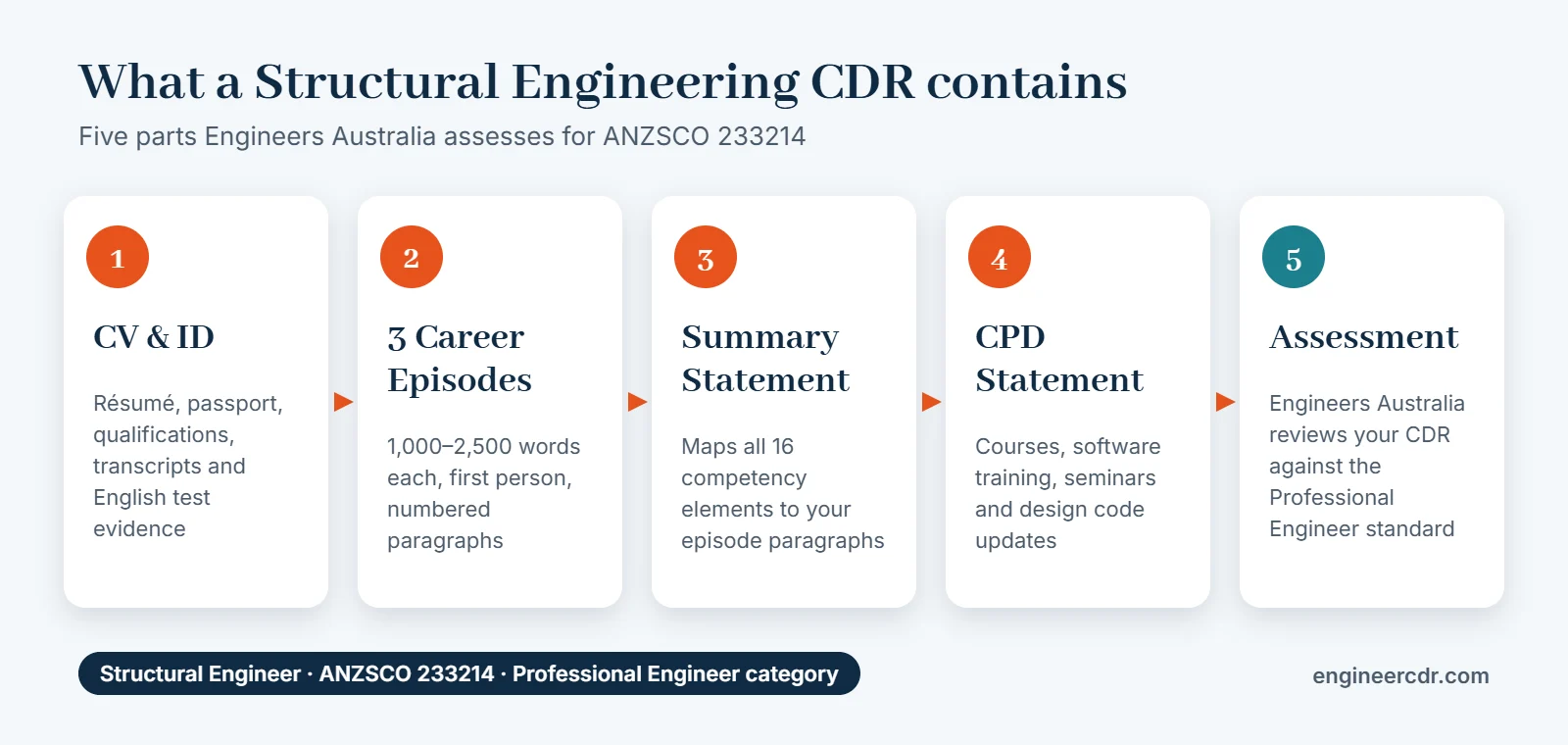
What a Structural Engineering CDR contains
| Component | What Engineers Australia expects | Tip for structural engineers |
|---|---|---|
| Career Episode 1 | An engineering activity or project, 1,000 to 2,500 words, first person | Pick a project where you did the analysis and member design yourself |
| Career Episode 2 | A different activity showing other competencies | Show another material or system, for example steel instead of concrete |
| Career Episode 3 | A third activity; may be study-based for recent graduates | Cover assessment, retrofit, construction support or project management |
| Summary statement | Maps every competency element to numbered episode paragraphs | Cross-reference paragraph numbers exactly |
| CPD statement | Written evidence of continuing professional development | List software training, code seminars, courses and site learning |
| CV and documents | Résumé, qualifications, transcripts, ID, English test evidence | Keep project names, dates and employers consistent with your episodes |
Career episode ideas for Structural Engineers
Choose projects where you made the engineering decisions. Strong options include:
- Reinforced concrete building frame: load take-down, analysis model, slab, beam and column design, and reinforcement detailing.
- Structural steel frame or portal building: member sizing, connection design, stability and bracing checks.
- Seismic assessment or retrofit: evaluating an existing building and designing strengthening measures.
- Bridge or culvert design: girder design, load models, bearings and serviceability checks.
- Foundation and substructure design: footings, pile caps and retaining elements, coordinated with geotechnical advice.
- Industrial structures: pipe racks, mezzanines, equipment supports and crane runway beams.
- Wind or dynamic analysis: wind load derivation for tall or slender structures and vibration checks.
- Condition assessment and repair: inspecting corrosion or cracking, then designing repairs.
- Precast, prestressed or timber design: panel, slab or truss design with connection detailing.
- Final-year or thesis project: finite element modelling or testing, suitable for recent graduates if your contribution is clear.
Design codes and software you can reference
Naming the codes, editions and software you actually used makes an episode credible. Use the codes of the country where the work was done. The table shows examples; only include what you personally worked with.
| Area | Codes and references | Common software |
|---|---|---|
| Loads and actions | AS/NZS 1170 series, ASCE 7, Eurocode 1, IS 875 | ETABS, SAP2000, STAAD.Pro, RISA |
| Concrete design | AS 3600, ACI 318, Eurocode 2, IS 456 | SAFE, ETABS, spColumn, Excel and MathCAD sheets |
| Steel design | AS 4100, AISC 360, Eurocode 3, IS 800 | Tekla Structures, SCIA Engineer, Robot, IDEA StatiCa |
| Timber and masonry | AS 1720, AS 3700, Eurocode 5 and 6 | Vendor truss and panel software, hand calculations |
| Seismic design | AS 1170.4, ASCE 7, Eurocode 8, IS 1893 | Response spectrum and pushover tools in ETABS or SAP2000 |
| Foundations | AS 2159 and local geotechnical codes | PLAXIS, SAFE, Excel design sheets |
| Drawings and BIM | Local drafting standards | Revit, AutoCAD, Tekla |
How to structure each career episode
Engineers Australia asks you to follow the engineering method of defining, planning and designing, delivering and evaluating. A four-part layout works well:
| Section | Approximate length | What to cover |
|---|---|---|
| Introduction | 50 to 100 words | Project title, dates, location, organisation, your position |
| Background | 200 to 500 words | Structure type, site, loads, codes, team and your role |
| Personal engineering activity | 600 to 1,800 words | What you did: load cases, analysis, member design, checks, problems solved and results |
| Summary | 50 to 150 words | Outcome, what you delivered and what you learned |
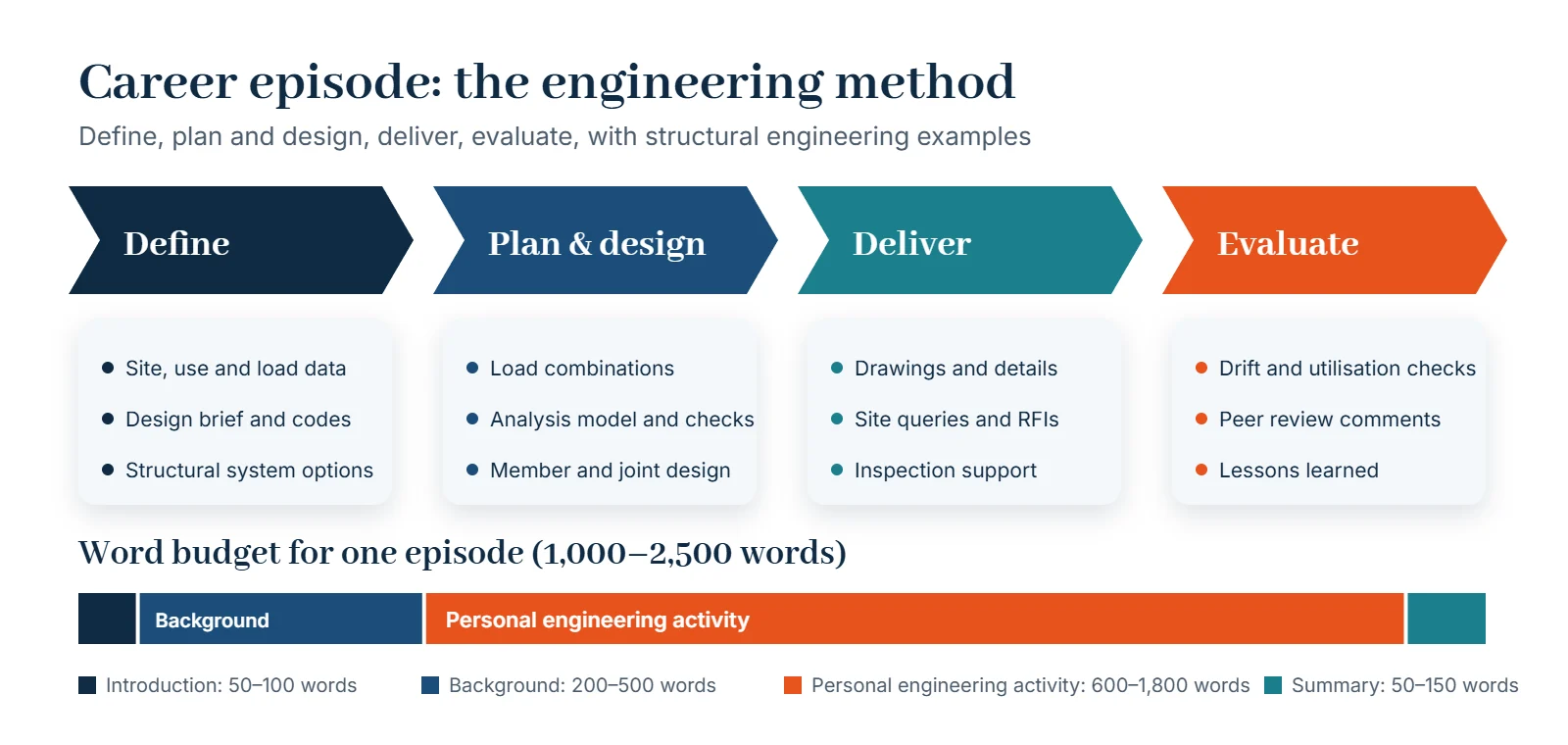
Write in the first person (“I checked”, not “we checked”), number every paragraph, and spend most of the word count on your personal engineering activity.
Illustrative excerpt (fictional, for structure only)
This short example is invented to show tone and level of detail. Do not copy it; your episodes must describe your own work.
CE 2.3 I defined the load combinations from the structural design actions standard, including dead, live, wind and earthquake cases, and entered them in the analysis model. I applied the floor loads as area loads and checked the total base reaction against a hand calculation.
CE 2.4 After analysis I checked inter-storey drift and the demand-to-capacity ratio of each column. A ground-floor column exceeded its capacity under the governing combination, so I increased the section and reinforcement and re-ran the model until all members passed.
How the summary statement maps competencies
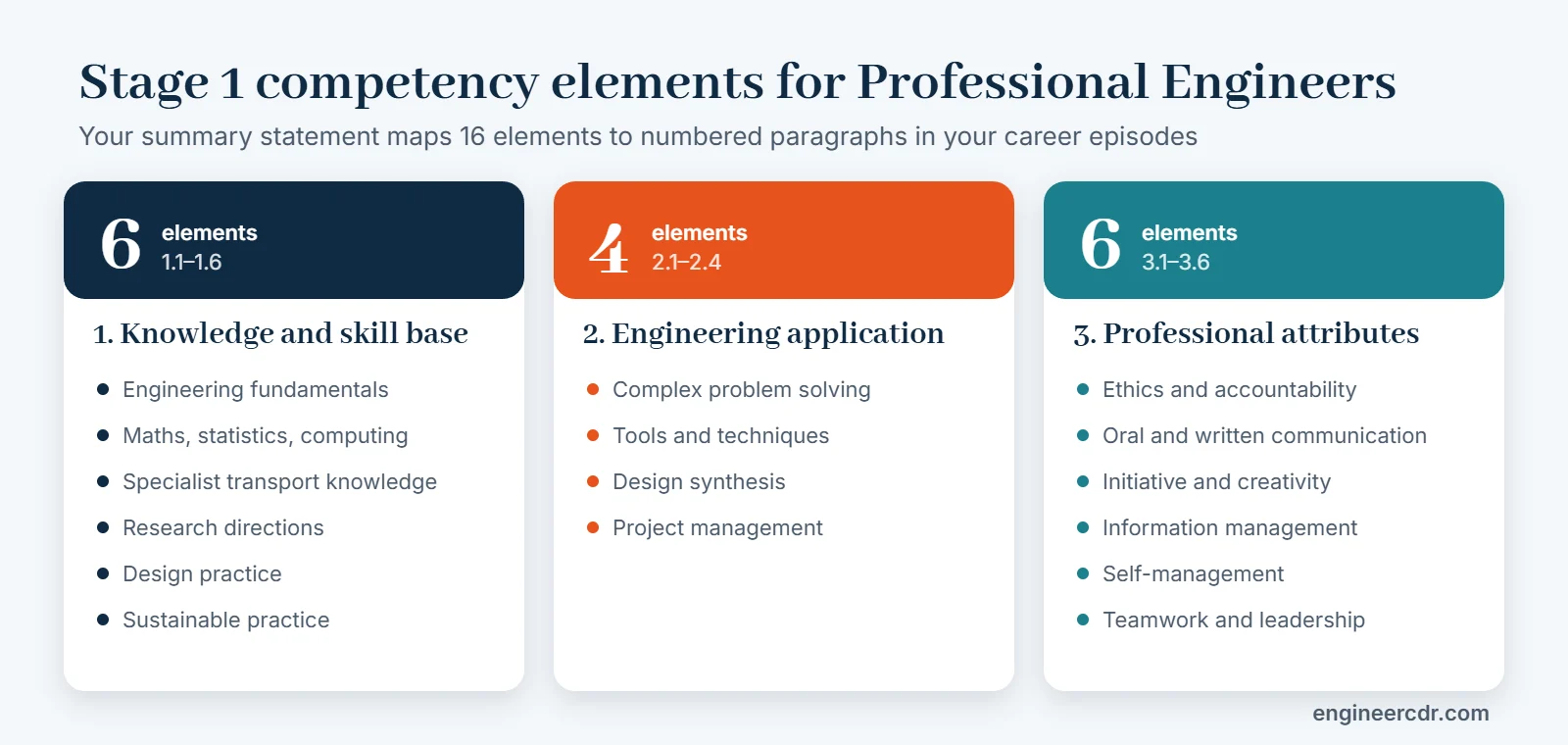
The summary statement is a table. For each of the 16 elements of the Stage 1 Competency Standard you quote the numbered paragraphs where you demonstrated it. The elements fall into three areas:
| Area | Elements | Structural engineering evidence |
|---|---|---|
| 1. Knowledge and skill base | 1.1 to 1.6 | Structural mechanics, materials behaviour, mathematics, specialist design knowledge, code practice, sustainability |
| 2. Engineering application ability | 2.1 to 2.4 | Analysis and design problem solving, software tools, design synthesis and detailing, project management |
| 3. Professional and personal attributes | 3.1 to 3.6 | Ethics and safety, communication with clients and contractors, initiative, documentation, self-management, teamwork |
Use the official Engineers Australia template for the Professional Engineer category and make sure every element is demonstrated at least once across your three episodes.
CPD examples for Structural Engineers
| Activity type | Examples |
|---|---|
| Software training | ETABS, SAP2000, STAAD.Pro, Revit or Tekla courses |
| Code and standards updates | Seminars on amendments to concrete, steel or loading standards |
| Technical courses | Seismic design, steel connection design, prestressed concrete, bridge engineering |
| Professional events | Structural engineering conferences, institution talks and webinars |
| Self-study | Reading research papers, design guides and case studies relevant to your projects |
| On-the-job learning | Design reviews, mentoring, site inspections and construction problem solving, with dates and outcomes |
Common reasons a Structural Engineering CDR is rejected
- Copied or ghost-written content that fails Engineers Australia’s plagiarism checks
- Using “we” so your personal contribution is unclear
- Describing the building or bridge but not your own calculations and decisions
- Citing a code without saying which edition or how you applied it
- Software screenshots or outputs with no explanation of your checks
- Missing competency elements or wrong paragraph references in the summary statement
- Episodes shorter than 1,000 words or far above 2,500 words
- Dates, employers or project titles that do not match your CV
How to write your Structural Engineering CDR, step by step
- Download the current Engineers Australia migration skills assessment booklet and competency templates.
- List your projects and pick three with clear personal analysis and design work.
- Collect the load cases, calculations, models, drawings and code clauses for each project.
- Draft each episode in four sections, first person, with numbered paragraphs.
- Complete the summary statement by mapping each competency element to paragraph numbers.
- Prepare the CPD statement and a CV that matches your episodes.
- Review for originality, consistency, technical accuracy and grammar before you submit.
Frequently asked questions
How many career episodes do I need for a Structural Engineer CDR?
You need three career episodes. Each should be between 1,000 and 2,500 words, written in English in the first person.
Can I copy a CDR sample for structural engineering?
No. Engineers Australia treats copied work, or work written by another person, as plagiarism. The consequences include rejection and a reapplication ban of 12, 24 or 36 months. Use samples only to understand structure.
Which authority assesses ANZSCO 233214?
Engineers Australia assesses the Structural Engineer occupation for migration skills assessment purposes.
Which design codes should I cite in a structural career episode?
Cite the codes used in the country where you did the work, such as AS 3600 and AS 4100, Eurocodes, ACI 318, AISC 360 or the relevant Indian Standards, and state the edition you applied.
Which software can I mention?
Mention only software you actually used, such as ETABS, SAP2000, STAAD.Pro, SAFE, Revit or Tekla, and explain what you did with it, including how you checked the results.
Can I use a university or thesis project?
Yes, if you are a recent graduate. Engineers Australia allows study-based projects. For group projects, describe only your personal contribution.
What is the difference between Structural Engineer and Civil Engineer for a CDR?
Structural Engineer (233214) centres on analysing and designing structures, while Civil Engineer (233211) covers a wider range of civil works. Choose the code whose tasks best match the work you have actually done.
Is Structural Engineer on the skilled occupation list?
Occupation lists and visa eligibility change. Check the Department of Home Affairs website and your chosen visa subclass before you apply.
Get your Structural Engineering CDR reviewed
Engineer CDR provides CDR review, editing and plagiarism checking and summary statement guidance, so your own draft is clear, consistent and competency-mapped. For service details, see our CDR for Structural Engineers (ANZSCO 233214) page, or email info@engineercdr.com.
Want a second pair of eyes on your CDR?
Send us your own draft for review, editing and a plagiarism check against Engineers Australia’s requirements.
Related CDR samples and guides
- CDR sample for Civil Engineering (233211)
- CDR sample for Geotechnical Engineering (233212)
- CDR sample for Transport Engineering (233215)
- CDR report samples and structure guide
Sources: Engineers Australia, Prepare your Migration Skills Assessment application; ANZSCO 233214 occupation description. Requirements can change, so always check the current booklet.
