A failed CDR is not the end of your engineers Australia migration journey, it is often a sign that the report did not clearly prove your competency, contribution, and originality. In my experience, the strongest way to recover is to treat the rejection as feedback and rewrite the CDR around evidence, structure, and first-hand engineering experience.
What usually goes wrong
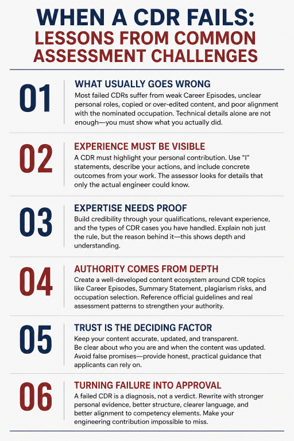
Most failed CDRs go through the same issues involving weak Career Episodes, unclear personal roles, copied or over-edited content, and poor alignment with the nominated occupation. I have seen applicants describe projects in impressive technical detail but still fail because they never showed what they actually did. Engineers Australia is not just checking whether the work was technical, it is also checking whether the story proves your engineering capability. Another common problem is writing generically. When the episodes sound like a project report copied from company documents, the assessor cannot see the applicant’s decision-making, problem-solving, or accountability. The CDR must feel personal, specific, and verifiable.


Experience must be visible
In a CDR context, use “I” statements to describe your actions and include concrete outcomes from your work. When reviewing technical writing, it should always look for details that only the actual engineer could know, such as a design change, a field issue, a recalculation, or a workflow correction.
Expertise needs proof
Expertise is built through credibility signals, not self-declaration. For CDR guidance, having a clear author bio, relevant qualifications, and a visible professional background is important. If you are writing as an engineer or project manager, state your discipline, industry experience, and the type of CDR cases you have handled. A useful pattern is to pair practical advice with a short explanation of why that advice matters in assessment. That shows depth without becoming academic. Readers trust writers who explain both the rule and the reason behind it.
Authority comes from depth
Authoritativeness is strengthened when your content sits inside a well-developed topic cluster. Instead of one isolated post on CDR failure, build related content on Career Episodes, Summary Statement errors, plagiarism risks, writing style, and occupation selection. This helps readers see that your site covers the subject thoroughly. You can also strengthen authority by referencing where your insights come from, such as official guidelines and professional standards. When your advice reflects real assessment patterns and practical writing experience, it becomes more useful and more credible.


Trust is the deciding factor
Trustworthiness matters most because applicants are making high-stakes decisions based on your guidance. A clear contact page, secure website, and visible author details all support trust. Most importantly, avoid promising guaranteed approval. A trustworthy article tells the reader what typically causes rejection, what can be improved, and what evidence matters most.
Second Chances in Engineering Migration: Rebuilding a Rejected CDR
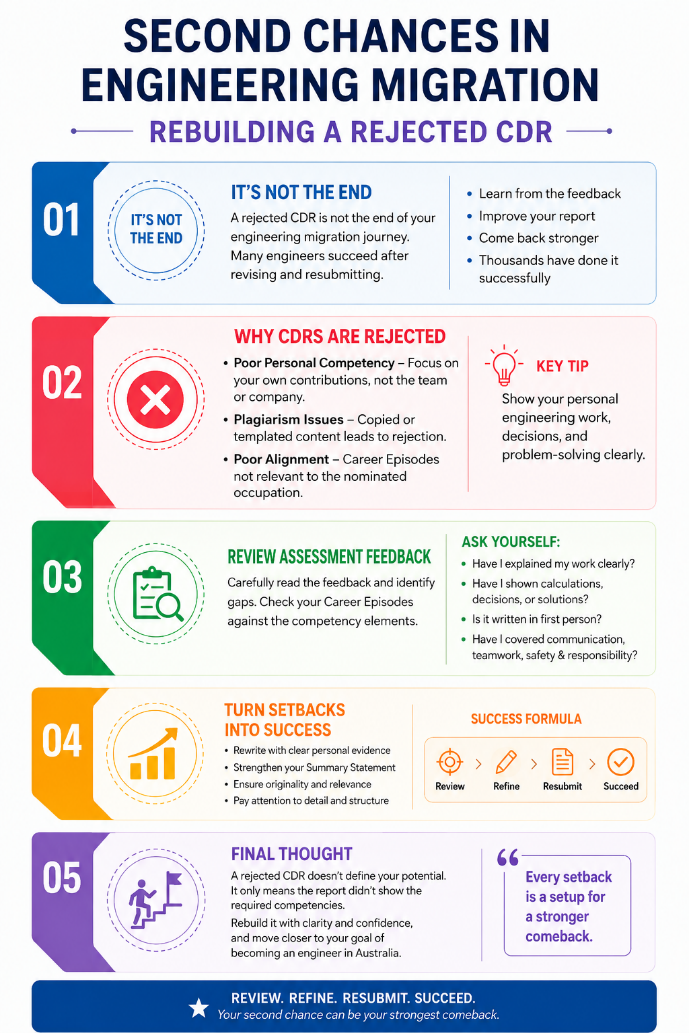
It is disappointing and stressful to receive a negative Engineers Australia Competency Demonstration Report (CDR). The documentation of Careers Episodes, Summary Statement and Continuing Professional Development (CPD) can take weeks or months to prepare for many engineers, and only to find that it has not satisfied the assessment criteria. A failed CDR should not be the end of an engineering migration journey, though. It is often used as a chance to review the application, find flaws, and resubmit a more powerful and compelling application. Thousands of engineers have been able to get a positive assessment after revising and resubmitting their CDRs.
The reasons for CDRs being rejected. Why CDRs are rejected.
Poor personal engineering competency is one of the most frequent causes of rejection of CDRs. Engineers Australia evaluates applicants for employment on their individual contributions to a project, not on its overall success. It’s also very common for people to talk about their company’s successes, their team’s work or the results of projects without clearly stating their own contribution. Plagiarism is another big issue. Engineers Australia employs advanced plagiarism detection software to detect content that has been copied or paraphrased extensively or from a template. You might have a legitimate experience, but provide it in a different format (language or sample documents), and it will be viewed as a bad experience.
Another difficulty is a poor alignment with the nominated occupation. For instance, if a candidate is applying for an Electrical Engineer position, he/she must make sure that the Career Episodes are predominantly Electrical Engineer-related activities. The assessor may be able to determine that the applicant does not have the required competencies for the chosen occupation if the episodes are too time-consuming, with a lot of management tasks or other disciplines.

Reviewing Assessment Feedback
A rejected CDR can be rebuilt, but the first step is to thoroughly review the Engineers Australia assessment result and any comments they may have made. Comments frequently tend to identify gaps in competency evidence, either clarity or quality, or lack of evidence. Applicants should use the competency elements listed in the Migration Skills Assessment guidelines to compare their Career Episodes. Questions to ask include:
- Were explanations of my personally designed, analysed and/or implemented work clear?
- Have I shown engineering calculations, engineering decisions or problem-solving?
- Do my Career Episodes use a narrative voice (first person)?
- Have I covered communication, teamwork, safety, and the responsibility of the professional?
These gaps can be identified, and this will be useful in planning an effective revision strategy.
Turning failure into approval
A failed CDR should be treated as a diagnosis, not a verdict. The solution is usually to rewrite with more personal evidence, better structure, clearer language, and stronger alignment to competency elements.

Final Thoughts
If a CDR is rejected, it does not say anything about the potential of the engineer or his / her professional value. It means that the report submitted failed to demonstrate the necessary competencies. By carefully editing and communicating technical contributions, engineers can turn a bad assessment into a learning experience and get closer to their professional career goal of becoming an engineer in Australia.
Why Technical Expertise Alone Is Not Enough for Engineers Australia
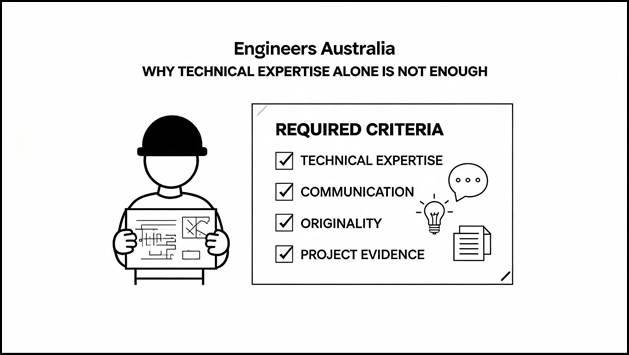
While technical expertise is important, it’s not all that Engineers Australia is looking for, and it’s not all you need to show in your assessment. It’s how you use, interpret and explain, and how you document that technical expertise. The key components of a good Career Episode are that it demonstrates competency, originality, communication and personal contribution beyond just the project itself.
Technical skills are not the only requirements for a job.
Engineers Australia evaluates your ability to work in a professional environment as a competent engineer, meaning that your work should be understandable, relevant and verifiable. If the episode contains a list of technical tasks or specifies technical requirements, your role, decision-making, and problem-solving may not be evident in it. The assessor wants to make sure that they see how you dealt with an engineering challenge, how you personally did and what you produced as a result of your actions. In other words, technical knowledge is the foundation, but the real test is whether you can turn that knowledge into a clear engineering story.
Communication matters
Many applicants think detailed terminology will impress assessors, but excessive jargon often creates the opposite effect. Career Episode should be written in clear English, include an explanation of acronyms, and be in the first-person voice to demonstrate the involvement of the career. This is particularly relevant as it is not a technical report, but evidence-based information. Even if you have done a good job in engineering, if the assessor cannot quickly grasp your contribution, it will not be selected.
Evidence and originality
Another key factor in this is originality. Plagiarism, whether intentional or unintentional, is unacceptable and will jeopardise an application. Your episode should be based on what actually happened to you, not what it looks like someone else’s project would be. It is safest to restate in your own words what is really happening, what choices are actually being made, and what is actually happening as a result of those choices.
Project choice matters
A CDR is not to be used for all engineering projects. Your Career Episode should demonstrate engineering engagement, problem-solving, and complexity, not routine administrative or low responsibility work. A good episode typically springs from design activities, implementation, troubleshooting, process improvement, or even research and development, where it is apparent that you have made a contribution. Where the project is either weak or irrelevant, technical ability can still exist but will not be evident in the Engineer’s Australia standard way of doing things.
What assessors want
Engineers in Australia seek competence in a variety of areas, such as analysis, design, execution, and professional judgement. Knowing how to do something is important, but it will need to be proven. A strong application is ideally a combination of engineering depth and clarity, structure, and personal accountability. That combination also allows an assessor to be impressed with not only your skill, but also your ability to communicate and apply your skill in the Australian engineering environment.

How to turn setbacks into success.
Migration in engineering is seldom a simple process. A number of the engineers currently working successfully in Australia have suffered from failure to pass an assessment and only gained approval with time. Carefully review feedback, rewrite Career Episodes with more personal evidence, enhance the Summary Statement and make sure the document is original to improve their odds of success. Having the correct amount of persistence, attention to detail, and honestly portraying engineering experience will make the difference between rejection and acceptance.
Final thought
In summary, technical skills will open the door to the conversation, but credible communication, originality and proof will secure approval for your CDR. To maintain a strong migration pathway, your Career Episodes should be proof of your technical competency and professional readiness.

Leave a Reply